
 This question came in from @holabendez for Science Week. What causes a double rainbow? The question is inspired by, in my opinion, the best youtube video since Keyboard Cat met Hall and Oates. Check out the Double Rainbow video below - if I'm this happy for just one day in my life, it will have been a happy life:
And now you'd better check out the Double Rainbow Song....
Rainbows are the result of the reflection and refraction of light by water droplets. They can be seen when there are water droplets in the air in front of you and sunlight shining from behind you at a low angle. You can also see them when looking at a sprinkler or hose, and sometimes they are created by the moon. But before we jump into the optics involved, let's review some high school physics.
White light and refraction:
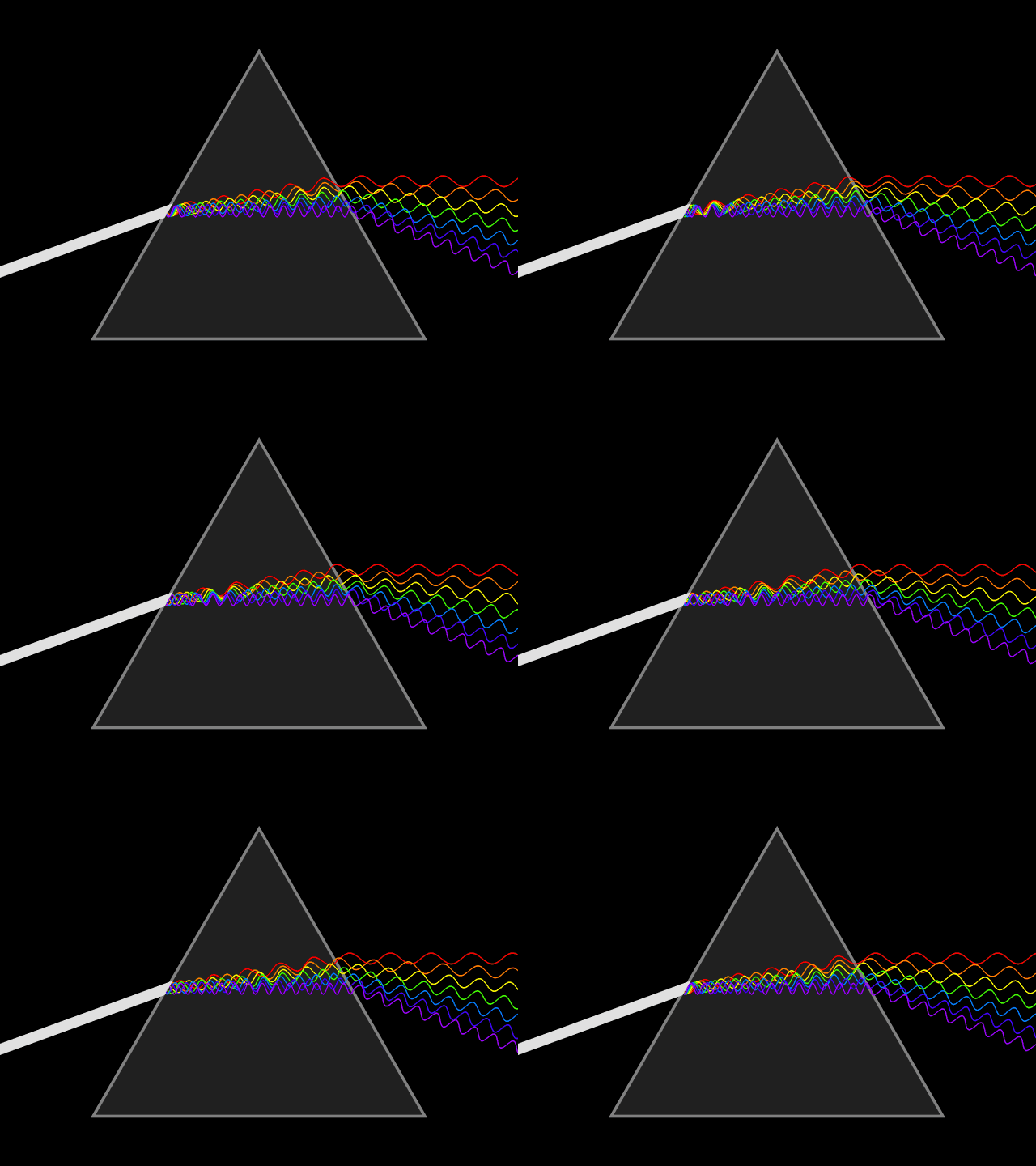 White light from the Sun is made up of all the various colours of visible light. Each of these colours has a different wavelength - red light (at one edge of the rainbow) has a wavelength of ~650 nm, whilst violet light (at the other edge) has a wavelength of ~400 nm.
When light travels from one medium (say air) to another (water), it changes speed, and if the light enters at an angle, it will bend. This is known as refraction. Shorter wavelength light (such as violet) refracts more than longer wavelength light (such as red). You can see white light splitting into its constituent colours in the image to the right.
NB: The Sun may not look white from here on Earth (it looks yellow), but if you were to observe it from space, it would look white. This is because the Earth's atmosphere scatters shorter wavelength light (like violet) more than longer wavelength light (red). See our story on the dust storm that turned Sydney red for more discussion of atmospheric scattering.
Primary Rainbow:
Rainbows result from a combination of reflection and refraction. The pictures below show the optics of how this works. The grey circles are water droplets. White light enters the droplet and is refracted, then reflected off the back of the droplet, before leaving the drop split into its constituent colours, again refracted. Some light will travel through the droplet - the reflection is not 100%. Red light leaves the droplet at a slightly higher angle than violet - this angle is independent of the size of the drop, but does depend on its refractive index. Seawater has a higher refractive index than rain water, so the radius of a rainbow in sea spray is smaller than a rainbow in the sky. The following picture shows the paths of red and violet light in the production of a rainbow - the other colours of a rainbow (for example green) travel somewhere between the two extremes.

When you see a rainbow, you are seeing light that has been refracted and reflected through water droplets, however the red colour does not come from exactly the same droplets of water as the violet colour. If you were able to isolate one particular water drop that produced some of the red colour you saw, the violet light from this drop would not meet your eyes - it would travel over your head. The following picture shows that multiple water droplets contribute to the colours you see - this is why red is the top colour in the rainbow.

Secondary Rainbow:
In the immortal words of the above youtube video, a double rainbow, Oh My God, what does this mean? It means interesting optics. A secondary rainbow is produced when there is one extra reflection of light within the water drop. As some light is lost each time it hits the edge of the drop, the secondary rainbow is fainter than the first. It appears higher in the sky because the light exits the drop at a larger angle (50-53 degrees) than the primary rainbow (40-42 degrees).

The colours in the secondary rainbow are in reversed order to the primary rainbow.

The following picture shows how the rainbow appears in the sky with regards to the Sun and the observer. The same picture also makes sense for the secondary rainbow, however it would appear at a larger angle, and therefore could also appear later in the day when the Sun is higher in the sky - it would also have the colours reversed. If the Sun is higher than 42° (or 53° for the secondary), the rainbow is below the horizon and usually cannot be seen.

The reason that the rainbow is circular is that this is the only shape that reflects the light back to your eyes at 42° (or 53°) - water droplets below and above (or to the left and right) of the rainbow do not reflect the light to your eyes. What this means is that everyone sees a different rainbow. If you are looking at a rainbow and walk to a new position, the light you see in the new spot will have been reflected by different water droplets to the light you saw in the first spot. This is also why there is no pot of gold at the end of the rainbow - there is actually no end of the rainbow. A rainbow does not actually exist at a particular location in the sky - it all depends on your location and the position of the Sun.
It is possible to see a completely circular rainbow, but only if you are in a plane above the ground. In this case, you could look down and possibly see a rainbow whose centre is the shadow the plane. Climbing a mountain may not help you see a more complete rainbow as the mountain itself would cast a shadow, blocking the light which would cause the rainbow.
So even though a "double rainbow all the way across the sky" may seem a mystical experience, it's really just physics!
References:
G., T. (1938). Descartes' Discourse on Method Nature, 141 (3574), 769-769 DOI: 10.1038/141769c0


