
It's that time of year again, so I'd like to wish a HAPPY VALENTINE'S DAY to all.
To keep you in the loving mood, head over to the Mr Science series on love, The Loving Scientist.
If you are single and looking to get the attention of that one special person, The Mathematics of Looking Beautiful, The Science of Speed-Dating and Scientific Dating Tips are for you.
If you are lucky enough to be waist deep in romance, then check out some of the reasons why we fall in love and how this is a chemical process in the brain. Perhaps you're interested in older ladies, or even risky sex....
And if you think this whole love and sex thing is just one big joke, then perhaps the idea that those who are more sexually appealing may be dumber might be up your alley.
So to all of you out there, to those special someones in your lives, and they know who they are in mine, have a wonderful Valentine's Day. I can't get e-nuff of your love! Now go read up on your Loving Scientist, hire Love Actually from the DVD store and take from this day whatever you will. I know Hallmark and flower companies love it, but its still fun and worth embracing (if not for purely scientific purposes, of course)!
Tuesday, 13 February 2007


Thursday, 8 February 2007
Turbulent Townsville
Sometimes, the weather just doesn't work in your favour. Whether its raining out weekend sport or a BBQ, bringing an early end to the snow season, or simply melting the polar caps, raising sea levels and displacing millions of people, it can often be a minor inconvenience.
But on other occassions, it can be truly annoying.
I am currently sitting in the airport lounge in Townsville, North Queensland, awaiting my extremely delayed flight and hoping beyond hope that I don't have to stay here any longer. Townsville is a town that is built around James Cook University, the Army and the North Queensland Cowboys Rugby League team. However, univerisity hasn't gone back, much of the Australian Army is deployed overseas, and its not rugby league season yet, so suffice to say, there is not alot to do. Although, I'm not sure whether I would be tempted by that combination of attractions in any case...
No, to be fair, Townsville has its fair sure of beautiful attractions and lovely people. I'm just grumpy - that grumpiness that only airports can bring out of you!
Northern Australia is currently in the grip of cyclonic weather conditions. Cyclone Nelson has cut off much of the north by road, and caused massive flooding. This is a very strange thing to see coming from Sydney, which like much of the rest of the country, is drought-striken and in a water crisis.
So for my flight to be delayed is not surprising. However, for my flight to be delayed because the plane is late from Sydney because of Sydney storms, whilst it is perfectly clear outside here in Townsville, is rather infuriating! (Marc - I'm adding this 6 hours after we were supposed to leave, and we're still here. Each hour they delay the departure time by an hour.)
OK, time to stop complaining, and make something sciencey out of all this. One of the "features" of the trip up, and considering the weather conditions probably the trip back, was turbulence. Turbulence is air movement that cannot normally be seen and whilst many people enjoy this aspect of flying, I struggle with it!
There are a number of ways that turbulence can come about:
Thermals - Air rises when it is heated by the sun, and cold air sinks. So if one mass of air heats up, this can cause air flow causing turbulence.
Jet streams - At high altitudes, there are fast air currents. These can shift, causing a disturbance in the nearby air.
Mountains - Air passes over mountains and causes turbulence as it flows above the air on the other side.
Wake turbulence - If you are flying near the ground, a passing plane or helicopter can set up small, chaotic air currents.
Microbursts - A storm can cause a strong downdraft close to the ground.
The danger with turbulence is that it cannot always be predicted. The cockpit suffers least from turbulence, whilst the rear of the plane cops most of the disturbance. You don't need clouds for turbulence, however I usually notice it most when flying through them. On the way up, the pilot tried to stay below the clouds that were causing the turbulence. However, after a period of time, the clouds got lower and lower, and the plane couldn't continue to stay below them. However, the pilot said we were too heavy to fly above them - so we flew in the clouds for the best part of the flight, and it was a bumpy ride!
Aircraft radars can't detect turbulence. Turbulence is the leading cause of in-flight injuries, so remember to keep those seat-belts done up! It can range from very mild, to the extremely dangerous (but rather unlikely) case of the plane being totally out of control with massive changes in altitude. Between 1981 and 1997, there were 342 reports of turbulence affecting major air carriers. Three passengers died, two of which were because they were not wearing seat belts. 80 suffered serious injuries, 73 of these were also not wearing their seat belts.
One example of turbulence was a flight from Singapore to Sydney with 236 passengers on board, as well as and 16 crew. The airplane encountered turbulence over central Australia when it hit an air pocket and dropped 100 m. Nine passengers, including one pregnant woman, and three crew members suffered neck, back and hip injuries, with one of the passengers requiring surgery. They were all not wearing seat belts.
I'll get this out on the podcast soon, assuming I get back..... (mp3 here)
But on other occassions, it can be truly annoying.
I am currently sitting in the airport lounge in Townsville, North Queensland, awaiting my extremely delayed flight and hoping beyond hope that I don't have to stay here any longer. Townsville is a town that is built around James Cook University, the Army and the North Queensland Cowboys Rugby League team. However, univerisity hasn't gone back, much of the Australian Army is deployed overseas, and its not rugby league season yet, so suffice to say, there is not alot to do. Although, I'm not sure whether I would be tempted by that combination of attractions in any case...
No, to be fair, Townsville has its fair sure of beautiful attractions and lovely people. I'm just grumpy - that grumpiness that only airports can bring out of you!
Northern Australia is currently in the grip of cyclonic weather conditions. Cyclone Nelson has cut off much of the north by road, and caused massive flooding. This is a very strange thing to see coming from Sydney, which like much of the rest of the country, is drought-striken and in a water crisis.
So for my flight to be delayed is not surprising. However, for my flight to be delayed because the plane is late from Sydney because of Sydney storms, whilst it is perfectly clear outside here in Townsville, is rather infuriating! (Marc - I'm adding this 6 hours after we were supposed to leave, and we're still here. Each hour they delay the departure time by an hour.)
OK, time to stop complaining, and make something sciencey out of all this. One of the "features" of the trip up, and considering the weather conditions probably the trip back, was turbulence. Turbulence is air movement that cannot normally be seen and whilst many people enjoy this aspect of flying, I struggle with it!
There are a number of ways that turbulence can come about:
Thermals - Air rises when it is heated by the sun, and cold air sinks. So if one mass of air heats up, this can cause air flow causing turbulence.
Jet streams - At high altitudes, there are fast air currents. These can shift, causing a disturbance in the nearby air.
Mountains - Air passes over mountains and causes turbulence as it flows above the air on the other side.
Wake turbulence - If you are flying near the ground, a passing plane or helicopter can set up small, chaotic air currents.
Microbursts - A storm can cause a strong downdraft close to the ground.
The danger with turbulence is that it cannot always be predicted. The cockpit suffers least from turbulence, whilst the rear of the plane cops most of the disturbance. You don't need clouds for turbulence, however I usually notice it most when flying through them. On the way up, the pilot tried to stay below the clouds that were causing the turbulence. However, after a period of time, the clouds got lower and lower, and the plane couldn't continue to stay below them. However, the pilot said we were too heavy to fly above them - so we flew in the clouds for the best part of the flight, and it was a bumpy ride!
Aircraft radars can't detect turbulence. Turbulence is the leading cause of in-flight injuries, so remember to keep those seat-belts done up! It can range from very mild, to the extremely dangerous (but rather unlikely) case of the plane being totally out of control with massive changes in altitude. Between 1981 and 1997, there were 342 reports of turbulence affecting major air carriers. Three passengers died, two of which were because they were not wearing seat belts. 80 suffered serious injuries, 73 of these were also not wearing their seat belts.
One example of turbulence was a flight from Singapore to Sydney with 236 passengers on board, as well as and 16 crew. The airplane encountered turbulence over central Australia when it hit an air pocket and dropped 100 m. Nine passengers, including one pregnant woman, and three crew members suffered neck, back and hip injuries, with one of the passengers requiring surgery. They were all not wearing seat belts.
I'll get this out on the podcast soon, assuming I get back..... (mp3 here)
For more info and some examples of turbulence incidents, see: Civil Aviation Safety Authority
For a fluid dynamics explanation, see here.
Tuesday, 30 January 2007
Science Year 2006
Before we get too far into 2007, and before I finally take down my Christmas lights, its time we took a look back at the science year that was 2006.
This story will feature on the podcast very soon - it will also be the 50th Mr Science podcast episode, and so will feature these stories, plus some music, recordings and a few other tidbits from the year that was. I will post about that story when I finish up the recording - sometime this week, sorry for the delay.
(Edit - The mp3 for this episode can be found here, or on the podcast.)
So, to the stories, and coming in in 10th place in my top 10 science stories of 2006 ...
10. A brave new world of transhumanism is upon us.
9. Weird Science
2006 had some weird and wonderful science. Here are two examples that caught my eye:
 a) Whales speak in dialects:
Scientists have eavesdropped on whale conversations and found that Pacific Northwest blue whales have different accents and sound different to western Pacific Ocean or Chilean blue whales. We don’t know why.
b) Penis Transplant Removed:
A 44-year old man who lost his penis in an unfortunate accident had it reattached. But not long after, Chinese doctors had to remove it again due to problems that you might not encounter in other microsurgery cases. The doctors stated that is was “because of the wife's psychological rejection as well as the swollen shape of the transplanted penis”. So much for “For better or worse”. Poor bloke.
8. Fields Medal No Show
Mathematicians are known to shun the limelight, but surely not awards ceremonies and even US$1 million? When the International Mathematical Union, meeting at the 2006 International Congress of Mathematicians in Madrid, announced the recipients of the 2006 Fields Medals - often called the Nobel Prize of mathematics – one recipient, Grigori Perelman, failed to show and declined the award.
In 2002-2003, Perelman worked out a proof of one of mathematics' oldest problems, the century-old Poincare conjecture. This result is not only a major achievement, but profoundly important with possible use in discovering the shape of the universe. It carries a bounty of $1 million from the Clay Mathematics Institute. It is expected that Perelman will win some or all of that money, and it seems quite unlikely that he will accept it! If you’re reading Grigori, I’ll have it!
7. Rats born to Mice
 If you asked a rat to “Come to Papa”, or indeed “Who’s your Daddy”, and assuming the rat could talk, then you could be surprised by the answer. In one of the weirdest scientific breakthroughs of 2006, scientists have produced offspring from sperm cells grown in a different species with rats giving birth to mice.
Scientists have been able to develop one animal’s sperm in another for about a decade, including human sperm in rats. However, now we know that this sperm is fertile.
We have reproductive biologist Takashi Shinohara and his colleagues from Kyoto University in Japan to thank. The breakthrough raises the possibility of generating viable human offspring by growing human sperm in other animals, but Shinohara is not in favour of pursuing that avenue. Besides the ethical minefield, he noted that animal viruses could encode themselves into the sperm DNA.
So next time you flippantly ask “who’s your Daddy”, or even curse that someone is “A son of a bitch”, listen carefully to their response. You might be surprised.
6. Neanderthal DNA Mapped
The disappearance of the Neanderthals and why we homo sapiens won the human race, when about 50 000 years ago we were neck and neck, is a mystery as we have never known exactly what Neanderthals were like. How were they like us? How did they differ? Were they intelligent or simply cartoon cavemen? If the answers to these questions have a genetic answer, then 2006 saw us take some great steps to discovering them. Svante Paabo of the Max Planck Institute for Evolutionary Anthropology in Leipzig, Germany, and his team have managed for the first time to obtain nuclear DNA sequences from a 45 000-year-old male Neanderthal from north-western Croatia. Their results also suggest that Neanderthals split from modern humans about 500 000 years ago, suggesting that they didn’t interbreed with our ancestors.
Using some the techniques in our number 7 story, perhaps one day we will be able to recreate the full Neanderthal genome (the team predicts the full genome will be sequenced within 2 years) and give birth to one.
 5. Steve Irwin's Death
Steve Irwin, probably one of the best known advocates for wilderness and animal conservation in the world, tragically passed away in 2006 in North Queensland, Australia. He was arguably Australia’s best-known science communicator, although he was more popular overseas, particularly in America, than he was at home. His unconventional methods of communicating his work – some say he provoked animals to get them to attack on camera in order to bring viewers to his Crocodile Hunter television series – drew criticism from some and inspired others, yet it is unarguable that Irwin will have a lasting effect on the environmental and conservation movements in Australia and around the world.
4. Cervical Cancer Vaccine
2006 saw a vaccine for cervical cancer approved for the first time. The vaccine, first developed by Australian of the Year, Professor Ian Frazer, is now available to those willing to pay for it. There are two vaccines out there - one from Merck, the other from GlaxoSmithKline. Both have demonstrated in clinical trials that they can prevent infection from the two types of the human papilloma virus (HPV) that account for up to 70 percent of cervical cancers. In the US, over 10 000 women contract invasive cervical cancer annually and nearly 4 000 die from it.
3. South Korean Fraud
Until 2006, South Korean Hwang Woo-Suk was considered a pioneer in the field of stem cell research. However, on May 12, 2006, Hwang was “indicted on embezzlement and bioethics law violations linked to faked stem cell research.”
So, he faked it all! His famous 2004 and 2005 Science Magazine articles in which he claimed to have succeeded in creating human embryonic stem cells by cloning, were found to contain vast amounts of fabricated data.
He also had a shot at cloning mammoths, fraudulently obtained money for his research and embezzled $A3.8 billion worth of state and civilian donations to his research team. In one saving grace for the researcher, investigators into the affair found that his claim to being the first to successfully clone a dog, was accurate. The dog, an Afghan Hound, was named Snuppy.
2. Pluto's Fall
In an even greater fall from grace, 2006 saw the astronomical demotion of Pluto from planet, to planetoid. The hub of all space knowledge, the International Astronomical Union (IAU), came up with the first ever definition of what it is to be a planet – and Pluto failed. At one stage, it looked as though our Solar System may have ended up with a number of new planets, including Pluto’s moon Charon, the asteroid Ceres and the newly discovered body 2006UB313. However, in the end, it was decided that because these bodies had not completely cleared their orbit of other space material and debris, they could not be officially called planets. So now we have only 8 planets.
“We made a mistake 76 years ago," says Mike Brown, an astronomer at the California Institute of Technology. “I thought that people would be too scared to demote Pluto. It is the right scientific decision.”
This has meant a tough job for text book writers around the world. But there is a nice symmetry now – in general, atoms are most stable when they have 8 electrons in their outer-most shell. Now we have a stable solar system with 8 planets. Intelligent Design? Convergent Evolution? Coincidence? Who knows!
1. Global Warming
 Former US Vice President and failed US Presidential candidate Al Gore has finally won an election – well at least the entirely undemocratic election that came up with this list. His Documentary, An Inconvenient Truth, has become the third-highest-grossing documentary of all time and brought the issue of global warming to forefront of the public consciousness.
2006 saw global warming become the most talked about scientific topic of the year. Some scientists denied it, others blamed everything from animal migrations to the performance of the local sporting team on it, but you certainly couldn’t ignore it – global warming was everywhere in the press. As it’s a process that takes of the order of 100 years to have an effect, it is difficult to prove, however many researchers in the field now think that global temperatures could rise by as much as 5 degrees Celsius, and sea levels by 20 feet. Some good news is that whilst carbon dioxide levels continue to climb, levels of methane, a far more potent greenhouse gas, have stabilised.
The debate has now caused the EU and California to adopt a carbon trading system. And even the Australian government has been forced to think about it – which given our reliance on dirty old coal as an energy source (despite having massive areas exposed to the sun and wind that could be used for solar or wind power), and also the fact that there could be a whole lot of Pacific Islanders without an Island to live on knocking on the Aussie and Kiwi doors if the sea levels rise, is only a good thing.
------
So there you have it. Let me know what you think - what were your highlights? And keep the Mr Science feedback coming in, so we can make this year bigger and better than the last.
This story will feature on the podcast very soon - it will also be the 50th Mr Science podcast episode, and so will feature these stories, plus some music, recordings and a few other tidbits from the year that was. I will post about that story when I finish up the recording - sometime this week, sorry for the delay.
(Edit - The mp3 for this episode can be found here, or on the podcast.)
So, to the stories, and coming in in 10th place in my top 10 science stories of 2006 ...
10. A brave new world of transhumanism is upon us.
Well almost. 2006 saw Harvard nanotechnologist Charles Lieber and colleagues demonstrate for the first time that transistors can control the function of individual living nerve cells.
“This work could have a revolutionary impact on science and technology,” Lieber said. “It provides a powerful new approach for neuroscience to study and manipulate signal propagation in neuronal networks at a level unmatched by other techniques; it provides a new paradigm for building sophisticated interfaces between the brain and external neural prosthetics; it represents a new, powerful, and flexible approach for real-time cellular assays useful for drug discovery and other applications; and it opens the possibility for hybrid circuits that couple the strengths of digital nanoelectronic and biological computing components”
“This work could have a revolutionary impact on science and technology,” Lieber said. “It provides a powerful new approach for neuroscience to study and manipulate signal propagation in neuronal networks at a level unmatched by other techniques; it provides a new paradigm for building sophisticated interfaces between the brain and external neural prosthetics; it represents a new, powerful, and flexible approach for real-time cellular assays useful for drug discovery and other applications; and it opens the possibility for hybrid circuits that couple the strengths of digital nanoelectronic and biological computing components”
More info at PhysOrg.com
9. Weird Science
2006 had some weird and wonderful science. Here are two examples that caught my eye:
a) Whales speak in dialects:Scientists have eavesdropped on whale conversations and found that Pacific Northwest blue whales have different accents and sound different to western Pacific Ocean or Chilean blue whales. We don’t know why.
More info at MSNBC
b) Penis Transplant Removed:
A 44-year old man who lost his penis in an unfortunate accident had it reattached. But not long after, Chinese doctors had to remove it again due to problems that you might not encounter in other microsurgery cases. The doctors stated that is was “because of the wife's psychological rejection as well as the swollen shape of the transplanted penis”. So much for “For better or worse”. Poor bloke.
More info at Live Science
8. Fields Medal No Show
Mathematicians are known to shun the limelight, but surely not awards ceremonies and even US$1 million? When the International Mathematical Union, meeting at the 2006 International Congress of Mathematicians in Madrid, announced the recipients of the 2006 Fields Medals - often called the Nobel Prize of mathematics – one recipient, Grigori Perelman, failed to show and declined the award.
In 2002-2003, Perelman worked out a proof of one of mathematics' oldest problems, the century-old Poincare conjecture. This result is not only a major achievement, but profoundly important with possible use in discovering the shape of the universe. It carries a bounty of $1 million from the Clay Mathematics Institute. It is expected that Perelman will win some or all of that money, and it seems quite unlikely that he will accept it! If you’re reading Grigori, I’ll have it!
More info at Scientific American and Science Magazine
7. Rats born to Mice
If you asked a rat to “Come to Papa”, or indeed “Who’s your Daddy”, and assuming the rat could talk, then you could be surprised by the answer. In one of the weirdest scientific breakthroughs of 2006, scientists have produced offspring from sperm cells grown in a different species with rats giving birth to mice.Scientists have been able to develop one animal’s sperm in another for about a decade, including human sperm in rats. However, now we know that this sperm is fertile.
We have reproductive biologist Takashi Shinohara and his colleagues from Kyoto University in Japan to thank. The breakthrough raises the possibility of generating viable human offspring by growing human sperm in other animals, but Shinohara is not in favour of pursuing that avenue. Besides the ethical minefield, he noted that animal viruses could encode themselves into the sperm DNA.
So next time you flippantly ask “who’s your Daddy”, or even curse that someone is “A son of a bitch”, listen carefully to their response. You might be surprised.
More info at Live Science
6. Neanderthal DNA Mapped
The disappearance of the Neanderthals and why we homo sapiens won the human race, when about 50 000 years ago we were neck and neck, is a mystery as we have never known exactly what Neanderthals were like. How were they like us? How did they differ? Were they intelligent or simply cartoon cavemen? If the answers to these questions have a genetic answer, then 2006 saw us take some great steps to discovering them. Svante Paabo of the Max Planck Institute for Evolutionary Anthropology in Leipzig, Germany, and his team have managed for the first time to obtain nuclear DNA sequences from a 45 000-year-old male Neanderthal from north-western Croatia. Their results also suggest that Neanderthals split from modern humans about 500 000 years ago, suggesting that they didn’t interbreed with our ancestors.
Using some the techniques in our number 7 story, perhaps one day we will be able to recreate the full Neanderthal genome (the team predicts the full genome will be sequenced within 2 years) and give birth to one.
More info at Scientific American, New Scientist (here and here) and Nature
5. Steve Irwin's DeathSteve Irwin, probably one of the best known advocates for wilderness and animal conservation in the world, tragically passed away in 2006 in North Queensland, Australia. He was arguably Australia’s best-known science communicator, although he was more popular overseas, particularly in America, than he was at home. His unconventional methods of communicating his work – some say he provoked animals to get them to attack on camera in order to bring viewers to his Crocodile Hunter television series – drew criticism from some and inspired others, yet it is unarguable that Irwin will have a lasting effect on the environmental and conservation movements in Australia and around the world.
4. Cervical Cancer Vaccine
2006 saw a vaccine for cervical cancer approved for the first time. The vaccine, first developed by Australian of the Year, Professor Ian Frazer, is now available to those willing to pay for it. There are two vaccines out there - one from Merck, the other from GlaxoSmithKline. Both have demonstrated in clinical trials that they can prevent infection from the two types of the human papilloma virus (HPV) that account for up to 70 percent of cervical cancers. In the US, over 10 000 women contract invasive cervical cancer annually and nearly 4 000 die from it.
More info at Scientific American
3. South Korean Fraud
Until 2006, South Korean Hwang Woo-Suk was considered a pioneer in the field of stem cell research. However, on May 12, 2006, Hwang was “indicted on embezzlement and bioethics law violations linked to faked stem cell research.”
So, he faked it all! His famous 2004 and 2005 Science Magazine articles in which he claimed to have succeeded in creating human embryonic stem cells by cloning, were found to contain vast amounts of fabricated data.
He also had a shot at cloning mammoths, fraudulently obtained money for his research and embezzled $A3.8 billion worth of state and civilian donations to his research team. In one saving grace for the researcher, investigators into the affair found that his claim to being the first to successfully clone a dog, was accurate. The dog, an Afghan Hound, was named Snuppy.
2. Pluto's Fall
In an even greater fall from grace, 2006 saw the astronomical demotion of Pluto from planet, to planetoid. The hub of all space knowledge, the International Astronomical Union (IAU), came up with the first ever definition of what it is to be a planet – and Pluto failed. At one stage, it looked as though our Solar System may have ended up with a number of new planets, including Pluto’s moon Charon, the asteroid Ceres and the newly discovered body 2006UB313. However, in the end, it was decided that because these bodies had not completely cleared their orbit of other space material and debris, they could not be officially called planets. So now we have only 8 planets.
“We made a mistake 76 years ago," says Mike Brown, an astronomer at the California Institute of Technology. “I thought that people would be too scared to demote Pluto. It is the right scientific decision.”
This has meant a tough job for text book writers around the world. But there is a nice symmetry now – in general, atoms are most stable when they have 8 electrons in their outer-most shell. Now we have a stable solar system with 8 planets. Intelligent Design? Convergent Evolution? Coincidence? Who knows!
More info at Mr Science and Scientific American
1. Global Warming
Former US Vice President and failed US Presidential candidate Al Gore has finally won an election – well at least the entirely undemocratic election that came up with this list. His Documentary, An Inconvenient Truth, has become the third-highest-grossing documentary of all time and brought the issue of global warming to forefront of the public consciousness.2006 saw global warming become the most talked about scientific topic of the year. Some scientists denied it, others blamed everything from animal migrations to the performance of the local sporting team on it, but you certainly couldn’t ignore it – global warming was everywhere in the press. As it’s a process that takes of the order of 100 years to have an effect, it is difficult to prove, however many researchers in the field now think that global temperatures could rise by as much as 5 degrees Celsius, and sea levels by 20 feet. Some good news is that whilst carbon dioxide levels continue to climb, levels of methane, a far more potent greenhouse gas, have stabilised.
The debate has now caused the EU and California to adopt a carbon trading system. And even the Australian government has been forced to think about it – which given our reliance on dirty old coal as an energy source (despite having massive areas exposed to the sun and wind that could be used for solar or wind power), and also the fact that there could be a whole lot of Pacific Islanders without an Island to live on knocking on the Aussie and Kiwi doors if the sea levels rise, is only a good thing.
------
So there you have it. Let me know what you think - what were your highlights? And keep the Mr Science feedback coming in, so we can make this year bigger and better than the last.
Monday, 22 January 2007
The Beer Drinking Scientists - Promo 3
The Beer Drinking Scientists have moved on to the 3rd and final destination of the night, so join Darren Osborne and myself as we tackle the Mars Global Surveyor, and the link between chillies and spider bites, in the final (but only for now) Beer Drinking Scientists.
Probably because it was near the end of the night, we also chat about a few Martian films and other assorted issues that seemed relevant at the time.
More info on the Mars Global Surveyor can be found here.
Enjoy - listen to the podcast here or the show directly here
Probably because it was near the end of the night, we also chat about a few Martian films and other assorted issues that seemed relevant at the time.
More info on the Mars Global Surveyor can be found here.
Enjoy - listen to the podcast here or the show directly here
Sunday, 14 January 2007
The Beer Drinking Scientists - Promo 2
Join Darren Osborne and myself as we again host the Beer Drinking Scientists.
This recording is from our second stop of the night, in the Rocks Sydney.
This recording is from our second stop of the night, in the Rocks Sydney.
In this edition, we discuss a massive ethanol / methanol stream discovered in space, and a scientific paper into "Beer Goggles" - why people are more likely to have "risky sex" when they have had too much to drink.
Enjoy - listen to the podcast here or the show directly hereFriday, 5 January 2007
Blogs and Awards
 Happy 2007 to all!
The kind people at First Science have asked me to be a blogger on their site, so to check out some extra Marc-opinions which are hosted on one of the best science resources on the net, check out www.firstscience.com - Your first stop for science online
First Science features news, articles, perspectives, science facts, games, scientific photographs as well as being one of the first innovative sites to offer TV to download. They have recently renovated their site, and it is very impressive looking now.
I have also been nominated in the 2007 Australian blog awards, so feel free to get over there, nominate this site in various categories and vote often when voting opens!
Friday, 29 December 2006
The Beer Drinking Scientists - Promo 1
Join myself and Darren Osborne as we bring you a new series called The Beer Drinking Scientists. In these podcasts, Darren and myself talk all things beer and science topics of the day.
In this very first episode, we visit the James Squires Brew House in Darling Harbour, Sydney, sample the local ales, give them a good discussion and rating, before tackling the scientific topic of how humans perceive the temperature.
The theory behind these podcasts is, as Darren says, that the beer might kill off some of the slower brain cells and allow the smarter ones to get down to business on the weightier scientific topics. And, we have a great time talking science in a social context.
Enjoy - listen to the show directly here.
In this very first episode, we visit the James Squires Brew House in Darling Harbour, Sydney, sample the local ales, give them a good discussion and rating, before tackling the scientific topic of how humans perceive the temperature.
The theory behind these podcasts is, as Darren says, that the beer might kill off some of the slower brain cells and allow the smarter ones to get down to business on the weightier scientific topics. And, we have a great time talking science in a social context.
Enjoy - listen to the show directly here.
Tuesday, 19 December 2006
Human Evolution
Humans are undoubtably still changing. Culturally, technologically, intellectually and emotionally, humans have always been evolving. But are we still biologically evolving? Or have our cultural, technological, intellectual and emotional advances stopped genetic selection and biological evolution? Early homo sapiens could not possibly have envisaged the world in which modern day humans live, or our amazing technological capabilities, but have our changes had anything to do with genetics, or simply our developing culture?
Check out the following story, and a panel discussion, on my podcast.
It is arguable that we are no longer at the mercy of natural selection. We are now born into an environment that is largely of our own making – thousands of generations before us have helped craft a habitat in which genetic selection is largely unneccesary for our survival. No longer are only the healthy or rich breeding, or the strong surviving – babies with genetic mutations now survive childbirth and those of us who can not chase down wild animals can buy food from the supermarket. Reproductive technology has allowed many more people to breed than in the past.
There is an argument that we are even causing "reverse evolution". Technology and medicine enables almost everyone to have children, preventing unfit genes from being purged from the gene pool.
"Relaxed selection combined with a high mutation rate is probably causing gradual deterioration of many functions, especially disease defences," Gregory Cochran, adjunct professor of anthropology at the University of Utah, told New Scientist.
With this in mind however, we need to take a look at the 2005 discovery of two genes by Bruce Lahn of the University of Chicago, one of which may have emerged as recently as 14,000 years ago and is now carried by 70% of the world’s population. The other may be as recent as 500 years old and is carried by 25% of the world’s population. Another example of recent genetic selection is in some parts of Africa where there has been an increase in the frequency of a gene which offers some protection against infection with HIV-1. And another very interesting example is the increase of the dopamine receptor gene DRD4. It is interesting because it is associated with attention deficit hyperactivity disorder and has somehow been selected for.
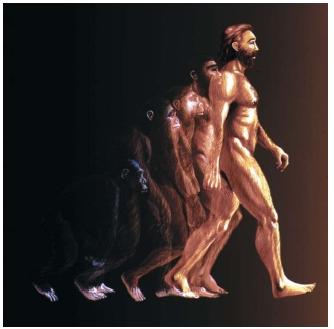 So it would seem that there are still genetic changes that are being selected for occurring within the species. These are very interesting findings, as racial and ethnic groups diverged somewhere between 50,000 and 100,000 years ago, meaning that various groups across the planet may differ genetically to various degrees. It could be a massive political issue if different world races were not bioligically equal – one would hope we are culturally evolved enough to deal with it.
But none of this should be much of a surprise. Our era of rapid technological progress, and hence a fast changing environment, is exactly the conditions under which natural selection should thrive. For example, the invention of dairy herding selected for a gene that gives adults the ability to digest milk sugars.
These days however, we are seeing more and more that human technology and culture help humans “adapt”, where to adapt in the traditional genetic fashion would take hundreds or thousands of generations. And with the ability of technology to deal with our troubles rapidly increasingly, this will be an escalating effect.
Given all this, where are we going to end up? Christopher Wills of the University of California, San Diego argues that our culture is the driving force in human evolution and has been driving the rapid evolution of the human mind. It began when it was the brains of our ancestors, as opposed to their physical attributes, that allowed them to succeed, and now Wills argues that in the modern world nobody can do everything, so the advantage lies in being good at something that not many others can do well.
"My prediction is that we are not simply getting smarter, we are selecting for more variability in our behaviours," he told New Scientist.
This is an interesting theory, as it means our culture is selecting for more variability within our gene pool, with this all pushing towards higher intelligence. Whilst Cochran thinks that we may be breeding out immunity to disease, he also thinks we may be selecting for intelligence – he recently published a paper claiming that natural selection has genetically increased the intelligence of Ashkenazi Jews in the past 1000 years, as they were forbidden to work in manual trades and had to make money in more ceregral activities (Journal of Biosocial Science, vol 37, p 1). Perhaps he thinks that our higher intelligence, combined with advances in technology, will more than make up for our increased vulnerability to disease.
We should also not forget the role of sexual selection in evolution – that is, how we choose our mates - but we have already discussed this in a number of articles on Mr Science already. And we have not yet even dealt with the role of computing and artificial intelligence in evolution. With our concepts of what we mean by free-will and consciousness racing to keep up with developments in artifical intelligence, this is one area that could completely change our concept of evolution and what drives it. There will be a time when we start genetically changing ourselves and incorporating technology into our bodies. There may be a time when we create artifically intelligent robots, and indeed we may well change other animals to have some form of intellect. Our environment will be entirely of our own making. Evolution will always exist, indeed probably progressing at such a pace in the future that we can not imagine it at the moment, but undoubtably, natural selection as driven by “traditional” means will not exist.
So where now for the human race? The October edition of Focus magazine published seven alternatives for the human race, some far sighted, some near sighted, some serious, some not. I suspect the future is a mix of all of them.
Check out the following story, and a panel discussion, on my podcast.
It is arguable that we are no longer at the mercy of natural selection. We are now born into an environment that is largely of our own making – thousands of generations before us have helped craft a habitat in which genetic selection is largely unneccesary for our survival. No longer are only the healthy or rich breeding, or the strong surviving – babies with genetic mutations now survive childbirth and those of us who can not chase down wild animals can buy food from the supermarket. Reproductive technology has allowed many more people to breed than in the past.
There is an argument that we are even causing "reverse evolution". Technology and medicine enables almost everyone to have children, preventing unfit genes from being purged from the gene pool.
"Relaxed selection combined with a high mutation rate is probably causing gradual deterioration of many functions, especially disease defences," Gregory Cochran, adjunct professor of anthropology at the University of Utah, told New Scientist.
With this in mind however, we need to take a look at the 2005 discovery of two genes by Bruce Lahn of the University of Chicago, one of which may have emerged as recently as 14,000 years ago and is now carried by 70% of the world’s population. The other may be as recent as 500 years old and is carried by 25% of the world’s population. Another example of recent genetic selection is in some parts of Africa where there has been an increase in the frequency of a gene which offers some protection against infection with HIV-1. And another very interesting example is the increase of the dopamine receptor gene DRD4. It is interesting because it is associated with attention deficit hyperactivity disorder and has somehow been selected for.
So it would seem that there are still genetic changes that are being selected for occurring within the species. These are very interesting findings, as racial and ethnic groups diverged somewhere between 50,000 and 100,000 years ago, meaning that various groups across the planet may differ genetically to various degrees. It could be a massive political issue if different world races were not bioligically equal – one would hope we are culturally evolved enough to deal with it.But none of this should be much of a surprise. Our era of rapid technological progress, and hence a fast changing environment, is exactly the conditions under which natural selection should thrive. For example, the invention of dairy herding selected for a gene that gives adults the ability to digest milk sugars.
These days however, we are seeing more and more that human technology and culture help humans “adapt”, where to adapt in the traditional genetic fashion would take hundreds or thousands of generations. And with the ability of technology to deal with our troubles rapidly increasingly, this will be an escalating effect.
Given all this, where are we going to end up? Christopher Wills of the University of California, San Diego argues that our culture is the driving force in human evolution and has been driving the rapid evolution of the human mind. It began when it was the brains of our ancestors, as opposed to their physical attributes, that allowed them to succeed, and now Wills argues that in the modern world nobody can do everything, so the advantage lies in being good at something that not many others can do well.
"My prediction is that we are not simply getting smarter, we are selecting for more variability in our behaviours," he told New Scientist.
This is an interesting theory, as it means our culture is selecting for more variability within our gene pool, with this all pushing towards higher intelligence. Whilst Cochran thinks that we may be breeding out immunity to disease, he also thinks we may be selecting for intelligence – he recently published a paper claiming that natural selection has genetically increased the intelligence of Ashkenazi Jews in the past 1000 years, as they were forbidden to work in manual trades and had to make money in more ceregral activities (Journal of Biosocial Science, vol 37, p 1). Perhaps he thinks that our higher intelligence, combined with advances in technology, will more than make up for our increased vulnerability to disease.
We should also not forget the role of sexual selection in evolution – that is, how we choose our mates - but we have already discussed this in a number of articles on Mr Science already. And we have not yet even dealt with the role of computing and artificial intelligence in evolution. With our concepts of what we mean by free-will and consciousness racing to keep up with developments in artifical intelligence, this is one area that could completely change our concept of evolution and what drives it. There will be a time when we start genetically changing ourselves and incorporating technology into our bodies. There may be a time when we create artifically intelligent robots, and indeed we may well change other animals to have some form of intellect. Our environment will be entirely of our own making. Evolution will always exist, indeed probably progressing at such a pace in the future that we can not imagine it at the moment, but undoubtably, natural selection as driven by “traditional” means will not exist.
So where now for the human race? The October edition of Focus magazine published seven alternatives for the human race, some far sighted, some near sighted, some serious, some not. I suspect the future is a mix of all of them.
 Homo astronauticus – We colonise the universe, but travel between the planets we inhabit takes too long, so the selective pressures (environmental, sexual, cultural ect) of each planet takes hold and eventually various different species of humans inhabit the universe.
- Homo cyberneticus – Over time we enhance ourselves with computing parts. Eventually, nothing biological remains and our brains and consciousness are merely parts of a computing network.
- Homo hippocraticus – Casearean births have selected for babies with bigger brains and we have naturally become smarter. Eventually we correct genetic diformaties and become ultraintelligent and beautiful.
- Homo climatalogicus – We live in a world of rapid climate change, and that means we live totally enclosed in climate controlled glasshouses. Natural selection could not keep up with this change, but our technology could.
- Homo postapocalyptics – An asteroid hits the Earth, we blow up most of the Earth in a nuclear explosion, or there is some other catastrophy wiping out most of the population – only the strong survive on the post-apocalyptic Earth.
- Homo immortalus – Nanotechnology and genetic engineering combine to end all death. Will we live in an overcrowded world where we have to work forever, or has technology taken us to the stage where we no longer need to work at all, and we take massive risks, all in the knowledge that technology will save us?
- Homo tribalensis – Genetic engineering has made us a very vain race in which we select for beauty. We look good.
Sunday, 10 December 2006
Movember Farewell - Time lapse and Memories
 Here is my video remembrance of Movember - the month in which a few of us grew moustaches to raise money for men's health.
Yes, I realise that this is not particularly "sciencey", but its good fun. A big thanks to the other members of the team, who also feature in this video.
The time lapse is not perfect, but some of the reflections, and some of the work of the other guys, particularly Adrian, are pretty funny. I quite liked my moustache, I miss the little guy.
You can watch this below or download it here
Wednesday, 6 December 2006
A couple of promotions
This is a message of thanks for a couple of companies.
 First off, a big thanks to The Podlounge for featuring the Mr Science Podcast on their homepage. You can see this feature here. Lots of love back to you, podlounge.
 And also a thanks to itunes, who recently rated the Mr Science Podcast top of their Natural Sciences section in the Australian store, after recently featuring it on their podcast homepage. Lots of love back to you also, itunes.
Thanks again to those who subscribe to the show.
First off, a big thanks to The Podlounge for featuring the Mr Science Podcast on their homepage. You can see this feature here. Lots of love back to you, podlounge.And also a thanks to itunes, who recently rated the Mr Science Podcast top of their Natural Sciences section in the Australian store, after recently featuring it on their podcast homepage. Lots of love back to you also, itunes.Thanks again to those who subscribe to the show.
Monday, 4 December 2006
Diffusion Science Radio - UP LATE
 I was very lucky to host the Diffusion Science Show "Up late" edition last Saturday night. Myself, Matt Clarke, Jacqui Hayes and Vanessa Gardos wandered into 2SER at 11pm, and broadcast across Sydney live until 1am.
This gave us a chance to talk about the topics about which we always wanted to chat, without worrying too much about offending anyone.
This recording actually has quite a lot of static on it, and whilst I have tried to clean it up, it was impossible to clean up with the tools I have, so you may find this a little hard to listen to in some places. It sounds like listening to a badly tuned radio, so it might be OK to listen to in the car, on the train or on a plane. We still thought it important to get this episode out there, at least so we can all hear it again!
Grab the file from the podcast here.
The topics we chat about include (all in a science context):
- Cricket
- The future of humanity
- Neanderthals
- Elephants
- What if human disappeared over night
- Nudist beaches
- Consciousness
Listen to this show here
Sunday, 3 December 2006
The Cloning Debate - Part 2
A few weeks back, I republished an article I wrote in 2001, in which I asked a number of prominent Australians their views on cloning.
I have attempted to re-contact these same people to see whether or not their opinions have changed during these 5 years. I am pleased to have received 3 replies so far, although a few of my initial contacts have proved very hard to find, or have move out of the field (Prof. Alan Trouson). Their opinions have been very interesting. I intend to take a closer look at some of these ideas in the near future - especially the views from Clonaid, who I will interview, probably in early 2007.
 Dr Paul Willis
One of Australia's leading science communicators, ABC Catalyst and radio Presenter, PhD in Palaeontology
I would say that my position has modified somewhat over the last 5 years. Therapeutic Cloning (TC) does offer the potential for cures to some pretty horrible diseases and, as such, ought to be pursued to see what it can really do. This should proceed at a research level. Once we know the true abilities of TC for various diseases, then we will be better placed to consider their implementation across society. But I am still concerned that we are looking at expensive medical treatments that will only really benefit a few, relatively rich people in the world. This particularly comes into focus when some of the more frivolous potential applications for TC are put on the table. Do we really need to spend billions learning how to make ego-copies of ourselves or developing complicated ways to avoid aging when that money could be more wisely spent saving many lives with much simpler, already proven medical technologies, treatments and basic public hygiene? This is an ethical problem with TC that is often ignored but should, in my view, be ahead of the more popular ethical issues such as embryonic destruction (which I think is a non-issue anyway because the embryos are destined for destruction anyway) or cross-species technologies (again, a non issue if there is no genetic material transfer between species).
 Thomas Kaenzig
Vice President, Operations
Clonaid
www.clonaid.com
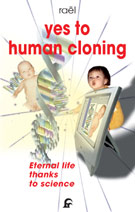
More and more people understand the benefits of the human cloning technology. Being in favor of therapeutic human cloning has already become "mainstream" today and the same thing will happen soon with reproductive human cloning. The ridiculous "ethics" argument brought up by opponents to human cloning is simply a last-gasp attempt by deist conservatives and orthodox dogmatics to keep humanity in ignorance and obscurantism, through the well tried fermentation of fear, the fear of science and new technologies.
Luckily, nothing can stop science ....
 Senator Natasha Stott-Despoja
Science and Research Portfolio, Australian Democrats
From her speech on the Prohibition of Human Cloning For Reproduction and the Regulation of Human Embryo Research Amendement Bill 2006 - Reproduced in part here after discussions with the Senator's office
I am a strong supporter of this technology (therapeutic cloning), in particular somatic cell nuclear transfer... Scientific endeavour has been an enduring area of interest to me. I have been particularly concerned with finding an appropriate balance between allowing the cutting-edge research and technology that we have to prosper and needing to protect our community through effective regulation of scientific activity...You need to understand how science progresses. It doesn't progress with a single step that means that you suddenly have cures. It moves incrementally towards a goal, and you gradually put in place bits of the jigsaw and solve various technical problems that are required... Those people who think that there is no moral problem with embryo research should be allowed to carry out that research and should not be prevented from doing so by the power of the law. Those people who think the research is wrong should be allowed to say so and to protest against what they believe to be wrong. And those who do not wish to participate in the treatments that arise from stem cell research should be allowed to avoid such treatments... Whether or not this technology will be progressed is beyond dispute. And if it does not happen here, it will happen elsewhere. Unless opponents are suggesting that we ban all imports of therapies derived using somatic cell nuclear transfer then Australians may well ultimately benefit from this technology, regardless of what happens here. But do we not want to be part of this? Do we not want invest in the potential and the hope that it presents us with? At stake is whether or not we want our research community to play the role that they are able to in this. If we allow this bill to pass, we can ensure that Australians benefit not only from the outcome but from the knowledge that is gained in the process and the increased speed with which progress may come about if Australias innovative prowess is allowed to be brought to bear on this challenge.
 Add to del.icio.us


I have attempted to re-contact these same people to see whether or not their opinions have changed during these 5 years. I am pleased to have received 3 replies so far, although a few of my initial contacts have proved very hard to find, or have move out of the field (Prof. Alan Trouson). Their opinions have been very interesting. I intend to take a closer look at some of these ideas in the near future - especially the views from Clonaid, who I will interview, probably in early 2007.
Dr Paul WillisOne of Australia's leading science communicators, ABC Catalyst and radio Presenter, PhD in Palaeontology
I would say that my position has modified somewhat over the last 5 years. Therapeutic Cloning (TC) does offer the potential for cures to some pretty horrible diseases and, as such, ought to be pursued to see what it can really do. This should proceed at a research level. Once we know the true abilities of TC for various diseases, then we will be better placed to consider their implementation across society. But I am still concerned that we are looking at expensive medical treatments that will only really benefit a few, relatively rich people in the world. This particularly comes into focus when some of the more frivolous potential applications for TC are put on the table. Do we really need to spend billions learning how to make ego-copies of ourselves or developing complicated ways to avoid aging when that money could be more wisely spent saving many lives with much simpler, already proven medical technologies, treatments and basic public hygiene? This is an ethical problem with TC that is often ignored but should, in my view, be ahead of the more popular ethical issues such as embryonic destruction (which I think is a non-issue anyway because the embryos are destined for destruction anyway) or cross-species technologies (again, a non issue if there is no genetic material transfer between species).
Thomas KaenzigVice President, Operations
Clonaid
www.clonaid.com
More and more people understand the benefits of the human cloning technology. Being in favor of therapeutic human cloning has already become "mainstream" today and the same thing will happen soon with reproductive human cloning. The ridiculous "ethics" argument brought up by opponents to human cloning is simply a last-gasp attempt by deist conservatives and orthodox dogmatics to keep humanity in ignorance and obscurantism, through the well tried fermentation of fear, the fear of science and new technologies.
Luckily, nothing can stop science ....
Senator Natasha Stott-DespojaScience and Research Portfolio, Australian Democrats
From her speech on the Prohibition of Human Cloning For Reproduction and the Regulation of Human Embryo Research Amendement Bill 2006 - Reproduced in part here after discussions with the Senator's office
I am a strong supporter of this technology (therapeutic cloning), in particular somatic cell nuclear transfer... Scientific endeavour has been an enduring area of interest to me. I have been particularly concerned with finding an appropriate balance between allowing the cutting-edge research and technology that we have to prosper and needing to protect our community through effective regulation of scientific activity...You need to understand how science progresses. It doesn't progress with a single step that means that you suddenly have cures. It moves incrementally towards a goal, and you gradually put in place bits of the jigsaw and solve various technical problems that are required... Those people who think that there is no moral problem with embryo research should be allowed to carry out that research and should not be prevented from doing so by the power of the law. Those people who think the research is wrong should be allowed to say so and to protest against what they believe to be wrong. And those who do not wish to participate in the treatments that arise from stem cell research should be allowed to avoid such treatments... Whether or not this technology will be progressed is beyond dispute. And if it does not happen here, it will happen elsewhere. Unless opponents are suggesting that we ban all imports of therapies derived using somatic cell nuclear transfer then Australians may well ultimately benefit from this technology, regardless of what happens here. But do we not want to be part of this? Do we not want invest in the potential and the hope that it presents us with? At stake is whether or not we want our research community to play the role that they are able to in this. If we allow this bill to pass, we can ensure that Australians benefit not only from the outcome but from the knowledge that is gained in the process and the increased speed with which progress may come about if Australias innovative prowess is allowed to be brought to bear on this challenge.
Add to del.icio.usSaturday, 25 November 2006
Elevators, Chimps and Love? Plus a little live radio
This week on the Mr Science Show Podcast, we tackle the topics of:
In other news, tonight (25/11/06) the Diffusion Science Radio Show is going live and up-late on 2SER between 11pm and 1am. We are taking the opportunity to produce some live and unscripted radio. Highlights from this show will appear on my podcast soon.
Grab this show here
- A 100,000 km space elevator
- Young chimp males like older chimp women
- Being tall and young makes you more attractive at speed dating
In other news, tonight (25/11/06) the Diffusion Science Radio Show is going live and up-late on 2SER between 11pm and 1am. We are taking the opportunity to produce some live and unscripted radio. Highlights from this show will appear on my podcast soon.
Grab this show here
Saturday, 18 November 2006
North Koreans, Mammoths, Invisibility and what did not make it to air on the Diffusion Radio Science Show
This week on the Mr Science Show podcast, we are taking a look at a number of different science news stories, as well as what I could salvage from one of most out-take ridden episodes of the Diffusion Radio Science Shows with which I have been involved - we had a great time, and its all good science! I have the raw recordings should anyone want them.
Our stories are:
Grab this show here
Our stories are:
- Dodgy North Korean Scientists attempting to clone mammoths
- New developments in invisibility (also see this past Mr Science story)
- Black and White television not so black and white
- Women allergic to semen?
- Psychology and cricket
Grab this show here
Friday, 17 November 2006
Rebirth of the cloning debate
The issue of human cloning is one that has been with us for some time.
Recently in Australia, a bill which would allow scientists to clone embryos to extract their stem cells for medical research has passed through the Senate and now awaits a lower house decision.
With this in mind, I have dug up an article I wrote for The Helix magazine in 2001 (editor Darren Osbourne). In this article I asked a number of prominent Australian's about their opinions on cloning, for some very interesting answers. I have attempted to track down these same people 5 years on to see whether or not their opinions have changed, and have had a couple of responses, so stay tuned for the 2006 results.
 Senator Natasha Stott-Despoja
Leader of the Australian Democrats in 2001
Cloning is no longer about whether it will be done but when it will be done. It is time to start sorting out the boundaries of what our community deems acceptable—or unacceptable, as the case may be. Cloning has a role to play in many possible medical treatments, either as a therapy or as a diagnostic. The paramount requirement from legislators in the immediate future will be to ensure the new cornucopia of genetic tools is used only for our benefit and not to unfairly discriminate.
 Senator Bob Brown
Australian Greens Senator for Tasmania and leader of the Greens party
Bob Bob Bob Bob Bob Bob Bob Bob Bob Bob Bob Bob Bob Bob Bob Bob Bob Bob Bob Bob Bob Bob Bob Bob Bob Bob Bob Bob Bob Bob Bob Bob Bob Bob Bob Bob Bob Bob Bob Bob Bob Bob Bob Bob Bob Bob Bob Bob Bob Bob Bob Bob Bob Bob – isn’t cloning boring? Nature has sorted all our genes and we re-arrange this ecological prescription at the peril of losing diversity and ecological robustness. The Precautionary Principle should, at least, apply.
Jean-Francois Aymonier
Spokesperson for Clonaid, a company aiming to be the first Human Cloning Company www.clonaid.com
Cloning frightens a lot of people. Especially the people who believe in God. Because if we succeed in cloning a human being, it proves that we can create life scientifically and God might not exist after all. That God doesn't exist is very hard to accept for those who have always believed in God. They don't want to be proven wrong so for them it is important to stop scientists from cloning. That is why they try to frighten us by imagining many terrible things that could be done with cloning. But cloning can also be used very positively. We Raelians at Clonaid think that a long time ago extra-terrestrial beings created life on earth scientifically thanks to cloning techniques. The first humans they created were clones. So cloning is a wonderful thing since we are all here thanks to cloning. Not only cloning will help cure many diseases but it will also make us understand how to create life and become eternal using different bodies or body parts. And one day it will be our turn to create life on another planet. That's why cloning is so fantastic.
Adam Spencer
Then Triple J Morning Presenter, Comedian and Science Communicator
One of the most disturbing aspects of the cloning debate is that again science has arrived at the ability to do something well before society has decided where it stands on the issue. This is happening more and more as the rate of discovery is increasing in so many controversial fields. It is so important that we start discussing the morality of this sort of research as soon as someone suggests that "perhaps one day we could do..." rather than wait until the press conference where it is announced "well we've got a few in the lab now if you want to come and have a look!” Hopefully we will all learn from this, we have to make our feelings known on the big issues, earlier not later.
 Associate Professor Catharine Lumby
Director of the Media and Communications Program at the University of Sydney, Journalist and Author
There is understandable public anxiety over the issue of cloning. I believe there are two reasons for this. Firstly, we live in a society where the speed of technological advances far outstrips our capacity to absorb their implications, let alone debate them in a considered manner. Secondly, cloning touches on an ancient philosophical conundrum - the relationship between the original and the copy. Plato expresses a concern that representations of real objects, if they are too exact, might be mistaken for the real thing - that images or copies have the capacity to trick the viewer. A similar kind of anxiety grounds the taboo in some religious orders against making likenesses of God (icons). A clone is essentially a perfect copy. The fear then arises that there will be no way of telling the original from its copy (or the human from its clone).
 Professor Alan Trounson
World Leader in Reproductive Technology
Centre for Early Human Development, Monash Institute of Reproduction and Development
Cloning human people is not ethical because of the risks of deformities to babies and problems for mothers during pregnancy. We know this from our studies on cloning Dolly the sheep and many other animals. We are studying cloning of animals to try and understand what goes wrong and to see if we can correct this. If we are successful we may be able to use cloning for cows to produce more milk, milk that is better for little kids in poor countries and cheap medicine to help sick people all over the world.
Dr Paul Willis
ABC Catalyst and radio Presenter, PhD in Palaeontology
I think that we all need to take stock of the context in which cloning is proposed. It's all very impressive to be able to clone people, sheep or cattle but do we really need to? The biggest problem this planet faces is too many people so why exacerbate the problem by producing more? Further, the only people who will be able to afford cloning will be the rich who are also the worst offenders for wasting the resources of the earth. Producing more of them only makes matters worse. I really have no opinion on the ethics of cloning and can see arguments for both sides, but I think that the wider context of cloning is emphatic; we don't need more people no matter how we want to make them.
Dr Graham Phillips
Then ABC Catalyst Presenter, author and PhD in Astrophysics
I'm in favour of therapeutic cloning - creating cloned embryos that might one day allow replacement livers and kidneys for people. I know there are serious ethical problems with creating embryos purely for medical purposes, but I think there are even more serious problems by not doing this. In effect this means sentencing people who need the new organs to earlier deaths. As far as the other sort of cloning goes - creating cloned adults - I guess my attitude is it will eventually happen and it will turn out to be not such a problem. After all, biologically, a clone is just an identical twin. But I don't think we should be attempting to create adult clones any time soon - the techniques are simply not safe enough yet.
Brian Alexander
Then Journalist for US Magazine Wired – www.wired.com
The subject of human cloning has occupied the better part of one year of my life. In the process of researching and discussing human cloning for the U.S. magazine Wired, I have met a number of very interesting people, including scientists who say they would like to help clone a human being, people who would like to be cloned, and people who feel strongly that nobody should ever be cloned. After all this time, I have come to the following conclusion: human reproductive cloning does not really matter. Someday soon, the issue of whether cloning is safe will go away. Then, there will be a human clone. And that clone will be, simply, a baby. The world will not change. There will be no "Brave New World," no sci-fi mass-produced human beings. A very few people, probably men and women who cannot have a baby any other way, may choose to clone to have a genetically related child. Hardly anybody else will ever want to have children this way. The one lesson I think we can take away from the controversy is that we need to look at science in realistic ways, not as if we all lived in a movie.
Recently in Australia, a bill which would allow scientists to clone embryos to extract their stem cells for medical research has passed through the Senate and now awaits a lower house decision.
With this in mind, I have dug up an article I wrote for The Helix magazine in 2001 (editor Darren Osbourne). In this article I asked a number of prominent Australian's about their opinions on cloning, for some very interesting answers. I have attempted to track down these same people 5 years on to see whether or not their opinions have changed, and have had a couple of responses, so stay tuned for the 2006 results.
Senator Natasha Stott-DespojaLeader of the Australian Democrats in 2001
Cloning is no longer about whether it will be done but when it will be done. It is time to start sorting out the boundaries of what our community deems acceptable—or unacceptable, as the case may be. Cloning has a role to play in many possible medical treatments, either as a therapy or as a diagnostic. The paramount requirement from legislators in the immediate future will be to ensure the new cornucopia of genetic tools is used only for our benefit and not to unfairly discriminate.
Senator Bob BrownAustralian Greens Senator for Tasmania and leader of the Greens party
Bob Bob Bob Bob Bob Bob Bob Bob Bob Bob Bob Bob Bob Bob Bob Bob Bob Bob Bob Bob Bob Bob Bob Bob Bob Bob Bob Bob Bob Bob Bob Bob Bob Bob Bob Bob Bob Bob Bob Bob Bob Bob Bob Bob Bob Bob Bob Bob Bob Bob Bob Bob Bob Bob – isn’t cloning boring? Nature has sorted all our genes and we re-arrange this ecological prescription at the peril of losing diversity and ecological robustness. The Precautionary Principle should, at least, apply.
Jean-Francois AymonierSpokesperson for Clonaid, a company aiming to be the first Human Cloning Company www.clonaid.com
Cloning frightens a lot of people. Especially the people who believe in God. Because if we succeed in cloning a human being, it proves that we can create life scientifically and God might not exist after all. That God doesn't exist is very hard to accept for those who have always believed in God. They don't want to be proven wrong so for them it is important to stop scientists from cloning. That is why they try to frighten us by imagining many terrible things that could be done with cloning. But cloning can also be used very positively. We Raelians at Clonaid think that a long time ago extra-terrestrial beings created life on earth scientifically thanks to cloning techniques. The first humans they created were clones. So cloning is a wonderful thing since we are all here thanks to cloning. Not only cloning will help cure many diseases but it will also make us understand how to create life and become eternal using different bodies or body parts. And one day it will be our turn to create life on another planet. That's why cloning is so fantastic.
Adam Spencer
Then Triple J Morning Presenter, Comedian and Science Communicator
One of the most disturbing aspects of the cloning debate is that again science has arrived at the ability to do something well before society has decided where it stands on the issue. This is happening more and more as the rate of discovery is increasing in so many controversial fields. It is so important that we start discussing the morality of this sort of research as soon as someone suggests that "perhaps one day we could do..." rather than wait until the press conference where it is announced "well we've got a few in the lab now if you want to come and have a look!” Hopefully we will all learn from this, we have to make our feelings known on the big issues, earlier not later.
Associate Professor Catharine LumbyDirector of the Media and Communications Program at the University of Sydney, Journalist and Author
There is understandable public anxiety over the issue of cloning. I believe there are two reasons for this. Firstly, we live in a society where the speed of technological advances far outstrips our capacity to absorb their implications, let alone debate them in a considered manner. Secondly, cloning touches on an ancient philosophical conundrum - the relationship between the original and the copy. Plato expresses a concern that representations of real objects, if they are too exact, might be mistaken for the real thing - that images or copies have the capacity to trick the viewer. A similar kind of anxiety grounds the taboo in some religious orders against making likenesses of God (icons). A clone is essentially a perfect copy. The fear then arises that there will be no way of telling the original from its copy (or the human from its clone).
Professor Alan TrounsonWorld Leader in Reproductive Technology
Centre for Early Human Development, Monash Institute of Reproduction and Development
Cloning human people is not ethical because of the risks of deformities to babies and problems for mothers during pregnancy. We know this from our studies on cloning Dolly the sheep and many other animals. We are studying cloning of animals to try and understand what goes wrong and to see if we can correct this. If we are successful we may be able to use cloning for cows to produce more milk, milk that is better for little kids in poor countries and cheap medicine to help sick people all over the world.
Dr Paul Willis
ABC Catalyst and radio Presenter, PhD in Palaeontology
I think that we all need to take stock of the context in which cloning is proposed. It's all very impressive to be able to clone people, sheep or cattle but do we really need to? The biggest problem this planet faces is too many people so why exacerbate the problem by producing more? Further, the only people who will be able to afford cloning will be the rich who are also the worst offenders for wasting the resources of the earth. Producing more of them only makes matters worse. I really have no opinion on the ethics of cloning and can see arguments for both sides, but I think that the wider context of cloning is emphatic; we don't need more people no matter how we want to make them.
Dr Graham Phillips
Then ABC Catalyst Presenter, author and PhD in Astrophysics
I'm in favour of therapeutic cloning - creating cloned embryos that might one day allow replacement livers and kidneys for people. I know there are serious ethical problems with creating embryos purely for medical purposes, but I think there are even more serious problems by not doing this. In effect this means sentencing people who need the new organs to earlier deaths. As far as the other sort of cloning goes - creating cloned adults - I guess my attitude is it will eventually happen and it will turn out to be not such a problem. After all, biologically, a clone is just an identical twin. But I don't think we should be attempting to create adult clones any time soon - the techniques are simply not safe enough yet.
Brian Alexander
Then Journalist for US Magazine Wired – www.wired.com
The subject of human cloning has occupied the better part of one year of my life. In the process of researching and discussing human cloning for the U.S. magazine Wired, I have met a number of very interesting people, including scientists who say they would like to help clone a human being, people who would like to be cloned, and people who feel strongly that nobody should ever be cloned. After all this time, I have come to the following conclusion: human reproductive cloning does not really matter. Someday soon, the issue of whether cloning is safe will go away. Then, there will be a human clone. And that clone will be, simply, a baby. The world will not change. There will be no "Brave New World," no sci-fi mass-produced human beings. A very few people, probably men and women who cannot have a baby any other way, may choose to clone to have a genetically related child. Hardly anybody else will ever want to have children this way. The one lesson I think we can take away from the controversy is that we need to look at science in realistic ways, not as if we all lived in a movie.
Thanks to someone at itunes....
I was browsing around itunes the other day, and discovered to my pleasure that they had featured my podcast on the front page of their podcast section. But not only am I grateful for that, I was pleasantly surprised to find that they had done some graphic design on my logo. Usually my podcast logo is the goofy photo of me at the Summer Palace in Beijing, however someone at itunes had added my name in a rather funky manner and the podcast title. You can imagine my surprise when I saw my ugly mug staring back at me with my name in rather large letters! So thanks itunes, the number of downloads and subscribers has increased because of it - the vast majority of my subscribers subscribe through itunes.

Add to del.icio.us
Add to del.icio.us
Monday, 13 November 2006
Movember Week 1 Documentary
Here is my take on week 1 of Movember.
It may not be very sciencey, or funny, but hopefully it will help us raise some money for a great cause. Sponsor me securely here and check out our team progress here. For more info, check out last week's Movember story
Watch this here
It may not be very sciencey, or funny, but hopefully it will help us raise some money for a great cause. Sponsor me securely here and check out our team progress here. For more info, check out last week's Movember story
Watch this here
Sunday, 5 November 2006
MO-vember - the science of moustaches
This month on Mr Science, we are celebrating November, or more particularly, Mo-vember. That is, for a good cause, I am growing a moustache, or a Mo. You can sponsor me to do this, and check out our work team's progress and varying states of scruffiness here (Well done Adrian!) Mo-vember, my moustache, and the science of hair and men's health was the subject of a panel discussion between myself and the other members of Diffusion Science Radio, and can be picked up as an mp3 on my podcast here.
The cause is male health, and research into depression, testicular cancer and prostate cancer. Men's health is an often overlooked topic, however when you look at it, men are far less healthy than women. The average life expectancy for men is six years less than females (presently 75 compared to 81). Men access health services 30-40% less than women, thereby denying themselves the chance for prevention and early detection of common diseases.
Money raised through this event go into the following areas:
Prostate Cancer in partnership with the Prostate Cancer Foundation of Australia (www.prostate.org.au) because every year in Australia 2,700 men die of prostate cancer - more than the number of women who die from breast cancer. Find out more
Male Depression in partnership with Beyond Blue (www.beyondblue.org.au) because one in six men suffer from depression at any given time but most don't seek help. Find out more
Testicular Cancer because it's the second most common cancer in young men aged 18 to 35. Find out more
Seeing my face is going to covered in an ugly growth for the next month, this week we are going to take a look at the science of hair. Facial hair is a secondary sex characteristic in human males. Most men develop facial hair in the latter years of puberty, whilst many women also have some facial hair, but generally after menopause and generally less than men.
Male pogonotrophy (beardedness) is often culturally associated with wisdom and virility. Excessive hairiness in women however is known as hirsutism, and is usually an indication of abnormal hormonal variation.
The amount of facial hair varies from individual to individual, and also between ethnic groups. For example, men from many East Asian, West African or Native American backgrounds typically have much less facial hair than those of European, Middle Eastern or South Asian descent.
But what is hair and why does it grow out of the side of our faces? Hair is a growth of dead cells protruding from the skin, and occurs in many animals, mainly mammals. However, in contrast to most mammals, humans do not have thick hair all over their bodies. While other great apes have relatively thin body hair and some bare areas, in comparison humans have very little. Theories about why humans, in comparison to apes, have less hair range from the idea that it was because early humans lived on African savannas and lost their hair in order to more easily control their body temperature, to the idea of neoteny, a form of sexual selection where one mate chooses another because of their youthful – that is, less hairy – looks. A more recent theory suggests that we lost our hair to reduce our vulnerability to fur-loving parasites.
There is a myth out there that hair and nails continue growing for several days after death. Often people have thought that others, previously thought dead, were still alive because of this. Sadly, this is untrue. The appearance of growth is actually caused by the retraction of skin as the surrounding tissue dehydrates, making it look like the nails and hair were growing. The skin was just shrinking.
As we age, hair becomes greyer as the pigment in the hair is lost and the hair becomes colourless. In general men tend to become grey at younger ages than women. I’m starting to get the odd grey hair and it scares me, I’m only 27!
But an interesting fact is that grey hair in itself is not actually grey – it is either white or dark –the head of hair appears grey because of these two colours mixing. As such, people who have blond hair when young usually develop white hair instead of grey hair when aging. Red hair usually goes sandy colour and then white.
But that’s only for the lucky ones who keep their hair. It is estimated that half of all men are affected by male pattern baldness by the time they are 50. This can also be seen in other primates and apparently has an evolutionary benefit – I wonder what that could be….
Hair thinkness ranges from 17 to 181 µm, and different parts of the human body feature different types of hair. From childhood onward, vellus hair covers nearly the entire human body. Rising levels of male hormones (androgens) during puberty causes a transformation process of vellus hair into terminal hair on several parts of the male body. Hair follicles respond to androgens, primarily testosterone, and this causes males to start growing thicker and denser body hair. Body hair grows for about 3 to 6 months before being pushed out by a following hair, whilst head hair grows at the rate of about 1.25 cm a month.
Check out www.movember.com.au for more information about this moustache growing spectucular, and if you feel like sponsoring me, go here or type “Marc West” into the sponsorship page and use your credit card. Its all for charity. Happy to do moustache requests, if it grows long enough, or to wear particularly stupid or outlanding clothes to the gala party, if sponsored the right amount!
Mo-vember, my moustache, and the science of hair and men's health was the subject of a panel discussion on Diffusion Science Radio on 2SER. You can listen here
The cause is male health, and research into depression, testicular cancer and prostate cancer. Men's health is an often overlooked topic, however when you look at it, men are far less healthy than women. The average life expectancy for men is six years less than females (presently 75 compared to 81). Men access health services 30-40% less than women, thereby denying themselves the chance for prevention and early detection of common diseases.
Money raised through this event go into the following areas:
Prostate Cancer in partnership with the Prostate Cancer Foundation of Australia (www.prostate.org.au) because every year in Australia 2,700 men die of prostate cancer - more than the number of women who die from breast cancer. Find out more
Male Depression in partnership with Beyond Blue (www.beyondblue.org.au) because one in six men suffer from depression at any given time but most don't seek help. Find out more
Testicular Cancer because it's the second most common cancer in young men aged 18 to 35. Find out more
Seeing my face is going to covered in an ugly growth for the next month, this week we are going to take a look at the science of hair. Facial hair is a secondary sex characteristic in human males. Most men develop facial hair in the latter years of puberty, whilst many women also have some facial hair, but generally after menopause and generally less than men.
Male pogonotrophy (beardedness) is often culturally associated with wisdom and virility. Excessive hairiness in women however is known as hirsutism, and is usually an indication of abnormal hormonal variation.
The amount of facial hair varies from individual to individual, and also between ethnic groups. For example, men from many East Asian, West African or Native American backgrounds typically have much less facial hair than those of European, Middle Eastern or South Asian descent.
But what is hair and why does it grow out of the side of our faces? Hair is a growth of dead cells protruding from the skin, and occurs in many animals, mainly mammals. However, in contrast to most mammals, humans do not have thick hair all over their bodies. While other great apes have relatively thin body hair and some bare areas, in comparison humans have very little. Theories about why humans, in comparison to apes, have less hair range from the idea that it was because early humans lived on African savannas and lost their hair in order to more easily control their body temperature, to the idea of neoteny, a form of sexual selection where one mate chooses another because of their youthful – that is, less hairy – looks. A more recent theory suggests that we lost our hair to reduce our vulnerability to fur-loving parasites.
There is a myth out there that hair and nails continue growing for several days after death. Often people have thought that others, previously thought dead, were still alive because of this. Sadly, this is untrue. The appearance of growth is actually caused by the retraction of skin as the surrounding tissue dehydrates, making it look like the nails and hair were growing. The skin was just shrinking.
As we age, hair becomes greyer as the pigment in the hair is lost and the hair becomes colourless. In general men tend to become grey at younger ages than women. I’m starting to get the odd grey hair and it scares me, I’m only 27!
But an interesting fact is that grey hair in itself is not actually grey – it is either white or dark –the head of hair appears grey because of these two colours mixing. As such, people who have blond hair when young usually develop white hair instead of grey hair when aging. Red hair usually goes sandy colour and then white.
But that’s only for the lucky ones who keep their hair. It is estimated that half of all men are affected by male pattern baldness by the time they are 50. This can also be seen in other primates and apparently has an evolutionary benefit – I wonder what that could be….
Hair thinkness ranges from 17 to 181 µm, and different parts of the human body feature different types of hair. From childhood onward, vellus hair covers nearly the entire human body. Rising levels of male hormones (androgens) during puberty causes a transformation process of vellus hair into terminal hair on several parts of the male body. Hair follicles respond to androgens, primarily testosterone, and this causes males to start growing thicker and denser body hair. Body hair grows for about 3 to 6 months before being pushed out by a following hair, whilst head hair grows at the rate of about 1.25 cm a month.
Check out www.movember.com.au for more information about this moustache growing spectucular, and if you feel like sponsoring me, go here or type “Marc West” into the sponsorship page and use your credit card. Its all for charity. Happy to do moustache requests, if it grows long enough, or to wear particularly stupid or outlanding clothes to the gala party, if sponsored the right amount!
Mo-vember, my moustache, and the science of hair and men's health was the subject of a panel discussion on Diffusion Science Radio on 2SER. You can listen here
Monday, 30 October 2006
Diffusion Science Radio goes LIVE
Diffusion Science Radio went LIVE this week on 2SER, during 2SER's radiothon subscriber drive. In this podcast episode, I host the show - my first time doing live radio - and am joined by Vanessa Gardos, Tilly Boleyn and Chris Stewart, who also produced the show.
You can hear my own feature on Stephen Hawking - you may have previously picked this up on the Mr Science feed. You can also hear Diffusion's own New York correspondent Kachina Allen talking about the scientific dangers of showering!
This was recorded during Radiothon, which means there are alot of comments regarding members and prizes and such things - you can phone up and join 2SER anytime should you like, but for first time listeners, Diffusion is not normally like this - there is usually a bit more science and entertainment!
A big plug to Justin Zeltzer who wrote the new theme to Diffusion - this was its debut.
Listen to this show here
You can hear my own feature on Stephen Hawking - you may have previously picked this up on the Mr Science feed. You can also hear Diffusion's own New York correspondent Kachina Allen talking about the scientific dangers of showering!
This was recorded during Radiothon, which means there are alot of comments regarding members and prizes and such things - you can phone up and join 2SER anytime should you like, but for first time listeners, Diffusion is not normally like this - there is usually a bit more science and entertainment!
A big plug to Justin Zeltzer who wrote the new theme to Diffusion - this was its debut.
Listen to this show here
Friday, 20 October 2006
Space Invaders Mind Control, Small Testes and Facial Expressions
 Mind control over Space Invaders
A 14-year-old who suffers from epilepsy, is the first teenager to play a two-dimensional video game using only the signals from his brain, a unique experiment conducted by a team of neurosurgeons, neurologists, and engineers at Washington University in St. Louis has found.
And the game was one of my favourites from the 1980s, Space Invaders.
This type of work has implications towards someday building biomedical devices that can control artificial limbs, for instance, enabling the disabled to move prosthetic arms or legs by simply thinking about it.
The teenager had an electric grid placed upon his brain to record electrocorticographic (ECoG) activity - data taken invasively right from the brain surface.
Eric C. Leuthardt, an assistant professor of neurological surgery at the School of Medicine, and Daniel Moran, assistant professor of biomedical engineering, performed their research on the boy who had the grids implanted so that neurologists and neurosurgeons could find the area in the brain that causes epileptic seizures.
Leuthardt and Moran connected the patient to a sophisticated computer running a special program known as BCI2000 which connected Space Invaders to the ECoG grid. They then asked the boy to do various motor and speech tasks, moving his hands various ways, talking, and imagining. The team could see from the data which parts of the brain and what brain signals correlate to these movements. They then asked the boy to play Space Invaders by actually moving his tongue and his hand. He was then asked to imagine the same movements, but not to actually perform them with his hands or tongue.
"He cleared out the whole level one basically on brain control," said Leuthardt. "He learned almost instantaneously... He mastered two levels playing only with his imagination. This really was a symphony of expertise ranging from neurosurgery, neurology, neuroscience, engineering, and computer science which was years in the making. The end result is something we can really be proud of."
You might be horny, but you have small testes
Some interesting news now for the tough cocky muscle men among us. Professor Leigh Simmons of the University of Western Australia and US researcher Professor Douglas Emlen of the University of Montana have shown that there is an evolutionary trade-off between the ability to fight off sexual competitors - ie be really tough - and reproductive potency.
They found that beetles with the biggest horns have the smallest testes. There is a trade off between the ability to find a mate and the ability to fertilise her.
The researchers looked at beetles of the genus Onthophagus, dung beetles known for the size and variety of their horns.
"What we did was test a fundamental assumption underlying evolution ... that males face a trade-off between competing for access to lots of females and investment in gaining fertilisation with those females," Simmons says.
"They need to have big horns to win fights and get females and they need to have big testes in order to win in sperm competition.
"But they can't do both, so species which invest very heavily in their horns tend to invest less in their testes."
There are other examples in nature also. Bats trade the size of their testes for brain power. Stalk-eyed flies, in which eye span width is a measure of sexual desirability, trade testes size for the width of their eyes.
And clearly is known in humans - those with the most expensive cars with the loudest sound system, clearly have the smaller penises.
Inherited Facial Expressions
Do you look like your father when you're angry? Probably more than you'd imagined. Facial expressions may be inherited.
According to Israeli scientists, every person has a set of facial expressions that is unique to them, a signature of their identity that remains stable over time. Stable patterns of facial expressions arise before a baby is six months old, but until now, scientists were unsure whether these patterns were learned or innate.
"We were interested to examine whether there is a unique family facial expression signature," said lead author Gili Peleg from the University of Hafa in Israel. "We assumed that we would find similarities between the facial expressions of relatives."
The study, published in the journal, Proceedings of the National Academy of Sciences, involved 21 participants who had been blind from birth, each with either one or two relatives who had normal vision. According to the researchers, blind individuals have no way of learning the facial expressions of their relatives by mimicry. The common perception that blind people touch other's faces to sense their expressions was revealed to be, in fact, very impolite behaviour.
The scientists induced six emotional states in each individual - sadness, anger, joy, think-concentrate, disgust and surprise - and then documented all the facial movements the person made while experiencing a particular emotion.
Forty-three different facial movements were recorded, including movements such as: biting the lower lip on the left-hand side; moving the lips while pressed together, as though chewing; rolling the upper lip inside the mouth; sticking out the tongue slightly while touching both lips; and pulling down the corners of the mouth while pushing the chin forward.
A computer program was used to allocate the blind individual to a family according to the types of movements observed and their frequencies. The blind individual was allocated to the correct family 80 per cent of the time when using information from all six emotional states.
"These findings indicate the existence of a hereditary basis for facial expressions," Peleg explained.
Listen to this show
Subscribe to:
Posts (Atom)


