
For those of you who follow this blog, you'll know my other passion is cricket.
Handled the Ball, a blog run by Nick Scott and myself, is back to ponder all things in that marvelous game. Nick started it up pre the World Cup 2007, and with all the controversy surrounding the current Indian tour of Australia, we couldn't remain in hibernation any longer.
Get over to http://handledtheball.blogspot.com for our occasional cricket musings.
Thursday, 31 January 2008

Thursday, 17 January 2008
Bosnian Ear Aches
 Being hospitalised when overseas is always difficult. But being hospitalised in a building fresh with bullet and shell holes from a war only a few years ago, where the signs are in Cyrillic, and where patients are literally spilling out from the doors, is something different altogether. I've had the pleasure of Hong Kong and Indian hospitals, but the Bosnian hospital was not only unexpected, but unexpectedly pleasurable.
Not only were the Mostar hospital staff friendly in tolerating my lack of local language skills, but the owner of the hotel in which we were staying escorted me to a local doctor and translated, and then took the specialist referral form from the doctor, with me in tow, to the hospital, negotiated our way through the masses of people following signs I could not read to the audiology specialist, where she again translated for me. She even helped me out with some KM as I only had Euro! As was the case in Hong Kong and India, the specialist was brilliant and spoke better English than me.
So, to the science of the problem. Once again I found myself with an ear infection - most likely from swimming in Dubrovnik. Otitis externa is an inflammation of the ear canal and outer ear, and something that some people, like myself, are sensitive to. For me, it came with total deafness in my right ear, and some blood. It can be a mixture of fungal and bacterial infection that attacks the skin after it has had some trauma - perhaps you cleaned your ear with a cotton bud, which you should never do.
Otitis externa usually begins with an itchy ear, after which pain and deafness can follow. The deafness may be caused by wax covering the eardrum, or in bad cases, from the external ear swelling so much that the ear cavity completely shuts. This is a dreadfully painful experience and did not happen to me this time, but has in the past. Often there is some discharge from the ear, often foul-smelling - in my case blood from the aggravated outer ear. I had tried some over-the-counter medication to dry up the wax, but that can worsen swelling if you have an infection.
I was prescribed something that was written in Cyrillic, so I didn't actually know what it was. However, a few questions and a little research led me to the following ingredients:
Dexamethasone is a corticosteroid that is used for reducing inflammation. Corticosteroids are naturally produced in the body by the adrenal gland, and dexamethasone is a synthetic adrenal corticosteroid. Inflammation can be caused by infection and is an attempt by the body to remove the injurious stimuli and start the tissue healing.
Neomycin is a aminoglycoside antibody. Such antibiotics are broad-spectrum, and so can defeat a wide variety of bacteria by binding to the bacterial cell and producing abnormal proteins. Such proteins can not keep the bacteria alive.
Acetic acid makes the ear acidic, which is difficult for the bacteria to survive in.
So there you go, more health problems that you can experience whilst travelling!
Listen to this show here (contains some great Eurovision music too!)
For more information, see netdoctor
Saturday, 22 December 2007
Counting Chimps
It has been known for a while that chimps are more evolved than humans - well, their genome has changed more than ours since our common ancestor - but recent studies have shown that chimps have outstanding numeracy abilities that outstrip our own in some cases.
Sponsor for this week's show - GotoMeeting: Try GotoMeeting free for 30 days! For this special offer, visit www.gotomeeting.com/techpodcast.
This week in the last Mr Science Show for 2007, we take a look at these special chimp abilities. Listen to the show here.
You can find more info on Plus and if you are not convinced, take a look at these videos:
Sponsor for this week's show - GotoMeeting: Try GotoMeeting free for 30 days! For this special offer, visit www.gotomeeting.com/techpodcast.
This week in the last Mr Science Show for 2007, we take a look at these special chimp abilities. Listen to the show here.
You can find more info on Plus and if you are not convinced, take a look at these videos:
Tuesday, 11 December 2007
Let's have a ramble about quantum physics
Sponsor for this week's show - GotoMeeting: Try GotoMeeting free for 30 days! For this special offer, visit www.gotomeeting.com/techpodcast.
Quantum Physics is a confusing topic for many. One person who makes a living out of understanding and explaining it is Professor Tony Sudbery.
I spoke to Professor Sudbery at the York Science Festival about all things quantum and his talk at the Festival entitled Alice and Bob in the Quantum Wonderland. Frankly, I was baffled by much of this conversation, although it was a thoroughly enjoyable chat!
You can listen to this show here
Quantum Physics is a confusing topic for many. One person who makes a living out of understanding and explaining it is Professor Tony Sudbery.
I spoke to Professor Sudbery at the York Science Festival about all things quantum and his talk at the Festival entitled Alice and Bob in the Quantum Wonderland. Frankly, I was baffled by much of this conversation, although it was a thoroughly enjoyable chat!
You can listen to this show here
Friday, 23 November 2007
Science, Cricket, Fitness and Psychology
Do you need to be fit to play cricket? Do the best batsmen in the world really have the ability to predict the type of ball they will receive before it even arrives? And is cricket really more of a mental game than a physical one?
These are the questions that we are tackling this week on Mr Science. We have discussed them in previous issues, but this week we are talking to the experts.
In this rather longer episode, we talk to Dr Rob Duffield from the School of Human Movement at Charles Sturt University who has found that indeed you really do not need to be as physically fit to play cricket as you do other sports such as football. We also have a chat about the direction of research with regards to sport and cricket in particular, and how scientific endeavour is reforming the way cricketers train and prepare for games.
We chat to Dr Allistair McRobert from Liverpool John Moores University who's work has shown that the best batsmen can predict to some extent where a bowler will bowl. This work also encompasses a look into the subconscious mental game of cricket and how the most successful players are more mentally prepared for the top level than lesser players.
Finally, I discuss the role of psychology in cricket and the various measures that are being put in place to look after the cricketer's brain.
I also wrote this up and some of it appeared in the Canberra Times - click here for a pdf of the article. I also wrote something for All Out Cricket but that article is not online, so you'll just have to go to the UK and buy it!
Listen to this show here
These are the questions that we are tackling this week on Mr Science. We have discussed them in previous issues, but this week we are talking to the experts.
In this rather longer episode, we talk to Dr Rob Duffield from the School of Human Movement at Charles Sturt University who has found that indeed you really do not need to be as physically fit to play cricket as you do other sports such as football. We also have a chat about the direction of research with regards to sport and cricket in particular, and how scientific endeavour is reforming the way cricketers train and prepare for games.
We chat to Dr Allistair McRobert from Liverpool John Moores University who's work has shown that the best batsmen can predict to some extent where a bowler will bowl. This work also encompasses a look into the subconscious mental game of cricket and how the most successful players are more mentally prepared for the top level than lesser players.
Finally, I discuss the role of psychology in cricket and the various measures that are being put in place to look after the cricketer's brain.
I also wrote this up and some of it appeared in the Canberra Times - click here for a pdf of the article. I also wrote something for All Out Cricket but that article is not online, so you'll just have to go to the UK and buy it!
Listen to this show here
Friday, 9 November 2007
The evolution of language in Europe
This week we talk to Dr Quentin Atkinson, an evolutionary psychologist from the University of Reading in the UK, about the evolution of language in Europe.
Languages, like genes, provide vital clues about human prehistory. The Indo-European languages, now spoken across Europe and the near East, show strikingly similar words for some meanings, indicating that they have come from a common source, now long forgotten. Atkinson and his team used statistical models of language evolution derived from evolutionary biology to date the age of the Indo-European language family and so test between the two main competing theories of Indo-European origins - the 'Kurgan horsemen' and 'Anatolian farming' hypotheses.
This podcast also comes from the York Science Festival. Listen to this show here.
Languages, like genes, provide vital clues about human prehistory. The Indo-European languages, now spoken across Europe and the near East, show strikingly similar words for some meanings, indicating that they have come from a common source, now long forgotten. Atkinson and his team used statistical models of language evolution derived from evolutionary biology to date the age of the Indo-European language family and so test between the two main competing theories of Indo-European origins - the 'Kurgan horsemen' and 'Anatolian farming' hypotheses.
This podcast also comes from the York Science Festival. Listen to this show here.
Tuesday, 6 November 2007
Sponsor Marc in Movember!
 It's that time again, Movember (the month formerly known as November). I'll be growin a Mo (slang for Moustache) to raise funds for The Prostate Cancer Charity.
 - Prostate cancer is now the most common cancer diagnosed in men in the U.K. with at least one man dying every hour from the disease.
- Every year about 35,000 men in the U.K. are diagnosed with prostate cancer and about 10,000 men die from the disease.
- One man in 11 will be diagnosed with prostate cancer in their lifetime in the U.K.
To bring some science to this, you may remember last year's mo-tastic Mr Science take on it all. Following these links for all you will ever need to know about moustaches and science
- The science of moustaches
- Week 1 Movember 2006 Documentary
- Farewell Moustache - Time lapse and a look back
Movember is proudly grown by Bulldog Natural Grooming and Playboy.
Movember is proud partners with The Prostate Cancer Charity.
Tuesday, 16 October 2007
How maths can save your life, Euler and Plus Magazine
 I have recently become an editor of Plus Magazine, a free, award winning online mathematics magazine that has articles written by the world's great mathematicians and science communicators, including Stephen Hawking and Marcus du Sautoy. This is why I have been a bit slack on Mr Science...
This week's podcast is again from the York Science Festival, and the interview is featured on an upcoming episode of the new Plus podcast. I talk to Professor Chris Budd about all sorts of interesting maths from Euler, Maths Communication, modelling Santa getting around the world, how maths can save your life, climate modelling and how mathematicians can pick up at parties. Professor Budd loves his maths! If you like the maths podcast, get over to Plus and subscribe!
The mp3 can be found here.
We have recently launched a writing competition. The Plus new writers award is trying to find people who can bring mathematics to life. The competition is open to new writers of any age and from any background who can explain a mathematical topic or application they think the world needs to know about. The winning entries will be read by an international audience of over two hundred thousand in the June 2008 issue of Plus, and the winners will receive an iPod and signed copies of popular maths books by some of the best science writers today, and a subscription to the journal Nature, kindly donated by its publisher. The closing date is March 31st 2008.
The competition is kindly supported by the Maths, Stats and Operational Research Network, a Subject Centre of the Higher Education Academy, and the London Mathematical Society. More info can be found on the website
Thursday, 27 September 2007
York Science Festival Episode 1
This week's podcast comes from the BA Festival of Science, the UK's foremost celebration of science, engineering and technology and its impact on our society. This is the first of a series of podcasts.
We talk to Sue Hordienko from the organising committee to find out what it's all about, and have a chat to the following researchers presenting their work at the Festival:
We talk to Sue Hordienko from the organising committee to find out what it's all about, and have a chat to the following researchers presenting their work at the Festival:
- Clare Chandler - Factors affecting clinical decision making in northeast Tanzania
- Marco Columbo - University of Edinburgh - Mathematical Optimisation
- Simon Blamey - University of South Hampton - Modelling railway station usage
- Alice Courvoisier - University of Leeds - Solar Physics and Sun Spots
- Fiona Jordan - University College London - Cultural Evolution in the Pacific
Friday, 7 September 2007
Spoofing Biometric Security Systems
This week on the podcast, I talk to Associate Professor Stephanie Schuckers from Clarkson University about her research into biometric security systems - security systems based upon your physical traits such as fingerprint analysis, voice and face recognition and iris and retina scans. Stephanie's research aims to find vulnerable areas in such systems and so she has fooled fingerprinting systems with simple tools such as play doh.
I am publishing a complete article on biometric systems later this year with The Helix magazine.
Grab the mp3 here.
I am publishing a complete article on biometric systems later this year with The Helix magazine.
Grab the mp3 here.
Wednesday, 22 August 2007
Sex before Sport?

It is the virile sports-person's eternal question - should one abstain from a little bit of nookie before a big sporting event?
The question has again been raised, this time with regard to the 2007 Rugby World Cup. Favourites New Zealand have vowed to go without special cuddles for however long they remain in the tournament. The All Blacks have conspired methods to lose each World Cup since 1987, despite being indisputably the best team in the world throughout most of this period. It pains me to admit this being an Australian, but despite brief periods of dominance by the Wallabies and the Springboks, and a very timely peak by England in 2003, the All Blacks are always the team to beat.
So, the latest Kiwi strategy to grab hold of the Cup is to lay off the loving. But is there any scientific basis to this? Does sex really have an effect on your physical sporting performance, or is this a psychological tactic to have the players' minds ready on game day?
It is certainly not a new theory. Before the Olympics in Athens 2004, hundreds of athletes pledged not to indulge, however even more took the opportunity to do the exact opposite. 130,000 condoms and 30,000 packets of lubricant were made available to the athletes, and in Sydney, athletes had a quota of three condoms a day - and this did not meet demand! This is no real surprise if you think about the Olympic village atmosphere - thousands of very fit, attractive, young and confident males and females from all over the world, probably up for anything without a care in the world once their events were over. Perhaps this was something like a massive backpacker hostel where everyone was rich and attractive without the dodgy old local trying to pick up the Contiki tourists.
 Do those who do abstain have a performance advantage? Love him or hate him (I think he's great), WBA Super-Middleweight champion Anthony Mundine is one of Australia's best athletes. However, Mundine abstained for 10 weeks before his first world title fight against Sven Ottke, and we know what happened (Mundine was knocked out in the 10th round). I can not find any reports of Ottke abstaining.
One of the more amusing sex/sport anecdotes is the banning of former US 100 m champion and 1992 Olympic Bronze Medallist, Dennis Mitchell for showing high levels of testosterone. He had originally escaped ban within the US after claiming that his high levels were a result of having sex at least four times the night before and drinking five bottles of beer. The IAAF overturned this decision and banned him for 2 years.
There is no conclusive evidence that sex the night before an event can have an effect either way on your physical sporting performance, despite what Rocky Balboa's trainer Mickey said, "Women weaken legs."
"There are two possible ways sex before competition could affect performance," said Ian Shrier, a sports medicine specialist at McGill University in Montreal, Canada to National Geographic.
"First, it could make you tired and weak the next day. This has been disproved. The second way is that it could affect your psychological state of mind. This has not been tested."
There is a common perception that ejaculation draws testosterone from the body. Actually, it seems the reverse may be true, as testosterone levels rise in men during sex. Higher testosterone levels are good for explosive sports such as boxing or 100 m sprinting - perhaps Mitchell was telling the truth, and perhaps Mundine should rethink his strategy.
Most scientists also now think that the actual act of sex does not really tire you out physically - it only burns around 50 calories, depending on how you do it of course. What might be bad for you is if you stay up all night and deprive yourself of sleep, or if it was getting drunk that got you into bed in the first place.
Sex can also be relaxing, but the actual physical relaxation post-sex does not last into the next day. Indeed, perhaps sex with the wrong person could make you more agitated the next day. And whether or not being relaxed is a good thing for sport is another question. Certainly, some elite athletes take caffeine pills before a match, and this caused quite a stir in Australia when the then Wallabies captain George Gregan admitted as much. The effects of "legal drugs" such as caffeine would far outweigh the much milder effects of sex the night before.
I suspect the effect, if there is any, is physiological and differs greatly from athlete to athlete. By locking out partners from their hotel rooms, the All Blacks are creating a very tight team environment which may raise their performance. It is not so much the banning of sex, more the banning of non-team members, from their lives. That said, the partners are permitted to stay in the same hotel, if not the same room, and so there may be much sneaking through hallways at midnight. The strategies concerning partners on team trips varies from team to team, with the Australian cricket team now allowing partners to stay with the players. Different levels of personal autonomy work better for different teams.
There may be some difference here between the sexes. Israeli scientist Alexander Olshanietzky has said that women compete better after orgasm, especially high jumpers and runners. So if you are a female competitor, you can always use the argument on an unwilling partner, "it's for good of the country!"
For what it's worth, I'm no international sportsman, but I found that my cricket performance was always best after having enough coffee to make Alex Watson's effort look tiny (I somehow didn't realise my peculator was making my coffee 6 times the normal strength...). I was a fair shire batsman with a hundred and a couple of fifties under my belt in my late teens before sex - and more to the point, late nights and beer - played any part in my life. Nowadays, I struggle! But sport is a mind game, and as you get older, different factors weigh more heavily in your life, and standing around all day in the Australian sun doesn't quite hold the excitement that it used to! I suspect that all sport is like this. If you think that sex before a game is going to help you, then it will. The physical effects are most likely negligible, but if you are happy and confident, or feel loved by a partner, then you will perform better. This is how much of alternative medicine works. And if you are ensconced in your team environment before the game, as all professional teams are, and going through the physical preparations, then the physical effects of sex the night before are non-existant.
If, however, it made you happy and confident, or cranky and disappointed, that's when the effects might kick in.
The podcast can be found here - included are some very candid opinions from sports-people.
And now you can vote in the poll - let me know what you think.
Edit: Here are the results
| Yes - Good for your performance: |
 (32%) (32%) |
| No - Bad for your performance: |
| (25%) |
| I'll take it when I can get it: |
| (24%) |
| Only if you're married: |
| (5%) |
| Makes absolutely no difference to your performance: |
| (15%) |
Listen to this show here.
Monday, 20 August 2007
Why I never took sides
Growing up in 1980's Australia meant watching some absolutely fantastic television.
When you have ads and public television announcements like the following two clips, you can hardly blame any Australian for loving either religion or science! (The science one is not strictly an ad, but still cool.)
If you can not see the embedded clips, check out religion and science.
When you have ads and public television announcements like the following two clips, you can hardly blame any Australian for loving either religion or science! (The science one is not strictly an ad, but still cool.)
If you can not see the embedded clips, check out religion and science.
Monday, 13 August 2007
A Terrible Tragedy
 One of the great tragedies in modern memory is the extinction of the Yangtze Dolphin.
Indeed, it is something about which mankind should be ashamed.
The Yangtze Dolphin is the first large animal in 50 years to be driven from the planet, and only the fourth entire mammal family in 500 years to be destroyed. What makes it even more devastating is that it is entirely our fault.
Having lived on the planet for 20 million years, time of death was called on Wednesday 8th August with the dolphin officially declared extinct by a report in the journal of the Royal Society, Biology Letters. It is the first species of cetacean (whale, dolphin or porpoise) to be killed off by human activity.
The Yangtze Dolphin was no ordinary dolphin, and the extinction was not of the kind that occurs throughout the natural course of evolution. The Yangtze Dolphin is a freshwater dolphin that separated from other species millions of years ago, and had evolved so distinctly that it qualified as a mammal family in its own right.
The extinction is a dangerous warning. An astounding 10 percent of the world’s population – 600 million people – live in the Yangtze basin. Human activity in the region, including shipping and fishing, is to blame for the dolphin's demise. Container ships and the nets of fishermen have killed off the dolphin, otherwise known as baiji or white-fin. The dangerous fact is that the Yangtze has lost its top predator and the ecosystem is in a state of collapse. The collapse of the Yangtze ecosystem could effect the welfare and livelihoods of these 600 million people.
The Yangtze is a fast flowing river with many unique species. The Chinese alligator, the finless porpoise and the Chinese paddlefish – not seen since 2003 – are also on the brink of extinction.
The extinction notice has come after an intensive six-week search by an international team of marine biologists in December 2006. The last dolphin in a zoo, Qi Qi, lived in the Yangtze port of Wuhan but died of old age in 2002 at 22 years old. Unfortunately, the dolphins never bred in captivity. During the expedition, the scientists counted one large freight vessel every 800m. These container ships destroyed any chance the Dolphin had of navigating by sonar and it ran the risk of being hit by propellers.
The biggest threat came from nets and hooks used by fishermen. The dolphins became entangled or lacerated. Additionally, pollution from the construction of the Three Gorges Dam killed off much of their food source.
Is it the first large animal to become extinct in 50 years. The Caribbean monk seal was last seen in 1952. The three previous mammal families to be killed off are the giant lemurs of Madagascar, the island shrews of the West Indies, and the Thylacine (Tasmanian tiger). Perhaps more famously, the Dodo – a bird – has also recently been wiped from the Earth.
Humans have not of recent times had a great impact on Dolphins. Recently, a crew of Brazilian fishermen was captured on video killing 83 dolphins.
The complete destruction of this unique and high-order animal is more than a complete and utter tragedy, it is a disgrace and something in which we should be ashamed. As an Australian, I am certainly not jumping on my high horse, as Australia does not have a great record in this regard - the Thylacine and indigenous megafauna were killed off mainly by human activity. However, whilst the West has made many many mistakes and sounds hypocritical denouncing mistakes by the developing world, China is no longer a poor country. The development and destruction of the Yangtze represents the massive growth of the Chinese economy, and its terrible after-effects in the same way as deforested America or massively mined Western Australia. One can only hope that the sad loss of the baiji is a reminder to everyone of the destructive environmental events that have occurred in the past, and are very apparently still happening.
A very nice and poignant take on the matter is at Null Hypothesis
The mp3 for this podcast can be found here
Tuesday, 7 August 2007
A very cold war
Russia has claimed one of the most inaccessible areas on Earth with a feat of magnificent science and engineering that tests international law, explores hitherto unexplored geography and territory, and asserts the Kremlin’s power in an old-fashioned land grab.
Two minisubmarines planted a titanium alloy Russian flag on the ocean surface, 4261 m under the Arctic Ocean surface at the North Pole. It is the first time the technical feat of reaching the North Pole sea floor in a manned craft has been achieved and is not only a sign of Russian strength, but a clear indication of the fact that Russia wants to claim the possibly resource rich area. The submersibles were named Mir-1 and Mir-2 – clearly Russia has a penchant for calling their scientific explorer craft Mir.
Although politically charged, the trip had a number of scientific aims. Soil and water samples of the seabed were taken during the mission. The mission could also help sort out whether or not the Lomonosov Ridge, which runs between Russia and Greenland and on which the disputed region lies, is actually part of, or connected to, the Russian continental shelf.
Under international law, out to 12 nautical miles, a coastal state is free to set laws, regulate any use, and use any resource. Out to 200 nautical miles, a coastal state has an Exclusive Economy Zone and has sole exploitation rights over all natural resources. If there exists a continent shelf beyond this, then the coastal state can claim exploitation rights out to that point.
This is where the debate lies – the North Pole sits nicely between, and off the continental shelves of, Greenland (Denmark), Russia, Alaska (USA), Canada and Norway. Russia wants to establish that the Lomonosov Ridge is an extension of its continental shelf. Indeed, the wording of the United Nationals Law of the Sea is not too clear and allows a country to claim jurisdiction if the geology of the seabed is similar to the nearby continental shelf.
Russia had a claim denied by the UN in 2001, as it appears the ridge is separated from Siberia by a trough. Denmark had their claim rejected for similar reasons. However, the Russian claim looks slightly stronger as the geology on each side of the trough is similar, and it appears that the trough was created by the seafloor moving apart – perhaps the Lomonosov Ridge was once part of Siberia. The 2001 decision did not so much reject the proposition, more that more research needs to be done. Norway also submitted a claim in 2006.
So why bother with the treacherous journey? This was a trip in which the submersibles could easily have missed on return the opening in the ice created by the team’s nuclear powered icebreaker.
The reason, as it so often is these days, is oil and energy. According to the US Geological Survey, around a quarter of the world’s oil reserves are locked up below the icecaps of the Arctic Ocean. In a world where oil could run out sometime in the not too distant future, and alternative energies are not yet solving the world’s energy demands, access to traditional energy sources is vital.
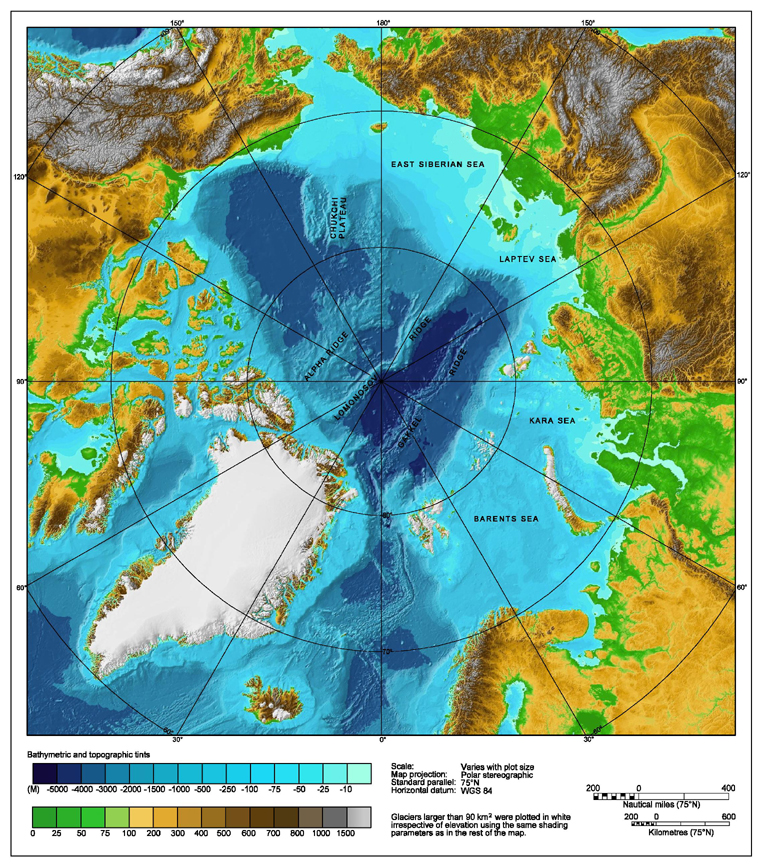 The Arctic floor is also home to massive unexploited gas fields. The Russian Shtokman field has an estimated reserve of 3,200 billion cubic meters of natural gas. Global warming is shrinking the ice that previously covered the surface, and the shrinking pool of global energy resources makes the extremely costly mission of salvaging these resources more profitable. The less ice there is, the easier it is to get at.
Added to the increased energy portfolio is the prospect of controlling a new Northwest Passage across the Arctic year-round.
Norway, Denmark and Canada are also attempting to establish their own sovereignty over the region, whilst the British Navy has increased Arctic patrols. Canadian and Danish scientists are currently mapping the north polar sea on two icebreakers, and Canada recently announced it would spend $7.4 billion Canadian to build up to eight armed ice-breaking naval ships to patrol its Arctic claim.
The Russian voyage is part of the ostensibly science research based Arktika 2007. The crew of MIR-1 comprised the pilot Anatoly Sagalevich, Soviet and Russian polar explorer Arthur Chilingarov, and Vladimir Gruzdev. The crew of MIR-2 comprised pilot Yevgeny Chernyaev of Russia, Mike McDowell of Australia and Frederik Paulsen of Sweden.
The MIR submersibles can dive to a maximum depth of 6000 meters. This makes them two of only five manned submersibles in the world that can dive deeper than 3000 m.
“Our mission is to remind the whole world that Russia is a great polar and research power,” said expedition leader Artur Chilingarov.
Anti-climatically, Gruzdev said:
“There is yellowish gravel down here. No creatures of the deep are visible.”
The mp3 for this podcast is hereTuesday, 24 July 2007
Book Review - The God Delusion by Richard Dawkins
 Having time on my hands has given me the opportunity to do something that in the past I have had little time to do, and that's read.
The most recent book that I have finished is the much debated The God Delusion by well-known evolutionary biologist and Chair for the Public Understanding of Science at Oxford University, Richard Dawkins. The reason that I am writing about it on a science-based blog is that Dawkins sets up his book as one side of the Science vs. Religion battle.
This intrigued me from the outset, being someone who did not, and still does not, believe there necessarily has to be a divide between the two areas. It could be argued that Dawkins is the world's most celebrated atheist, and I was keen to see what all the fuss was about. Perhaps having sabbatical time has also allowed me to ponder the big questions of life. My scientific background that has placed me either in scientific organisations or studying scientific courses over the last 11 years has led to me to marvel at the wonder of science, whilst my schooling at an Anglican school allowed me to see some of the best and worst of religion - for instance, on the good side, our Reverend was open-minded and gave out the Christian studies prize on occasion to atheists who presented reasoned arguments for their positions. On the bad side, it was announced to the school assembly of over 1000 boys that God made Adam and Eve, not Adam and Steve, which I'm sure further confused and possibly depressed a percentage of the angsty teenagers already struggling with their identity.
The opening salvo in the new release version that I read was Dawkins' response to criticism of previous releases. Immediately, the book was defensive and dogmatic. You can hardly blame someone for defending themselves against criticism, but this position immediately set the staunch stance against which there is no alternative for Dawkins. The language is strong and the message stronger. Dawkins considers religion, whether moderate or extremist, nonsense.
I have to admit that it took me around 200 pages to get into the book. The early part of the book deals with his arguments as to why God almost certainly does not exist. His definition of God for his arguments refers to a personal God, one that deliberately created the Universe and us, and listens to our prayers. His central argument is that, if there is a God that designed and fine-tuned us into the complex beings that we are, then He himself must indeed be more complex, and so who designed Him? Dawkins uses this argument to turn on its head the Creationist argument that we are so complex that we must be designed by a designer - if this is true, then God must be even more complex, and so who designed him?
For me, simply asking the question "who designed the designer" is not an answer in itself - it is entirely question begging. I personally do not believe that a God hand-crafted us each step along the way - I'm pretty happy with evolution. What, however, I do not believe is that Dawkins' little bit of nifty philosophical footwork answers our questions. It asks more. A question is not an answer. The assumption that the laws of nature are a given is completely question begging and not addressed. And can you really define what is complex outside of what we know in the Universe?
Perhaps this is not the point. At this stage of the book, it is the personal God that Dawkins is attacking, and not the God who started the Universe and then took a step-back, or the God that simply is the universe and the laws of nature - deism and pantheism respectively. Deism for him is "watered down theism" and pantheism is "sexed-up atheism". Throughout the book he credits scientists who could be defined as pantheists or deists as atheists unwilling to say as much or after the Templeton Prize. Perhaps these scientists simply disagree with him as opposed to not being as brave to "come out of the closet".
On a side note, and it is briefly mentioned in the book, there are people out there who do think that we are the results of more complex beings, and indeed that we are living in a computer simulation. Nick Bostrom uses probability theory to state that there are 3 propositions that could be true:
1) The fraction of human-level civilizations that reach a posthuman stage is very close to zero;
2) The fraction of posthuman civilizations that are interested in running ancestor-simulations is very close to zero;
3) The fraction of all people with our kind of experiences that are living in a simulation is very close to one.
The conclusion is that "unless we are now living in a simulation, our descendants will almost certainly never run an ancestor-simulation."
Interesting... Perhaps there is a "God" out there running our lives, and perhaps he is a posthuman creature of super-intelligence. Dawkins allows this argument with an off-hand remark, but not the God argument.
As I write, I realise that I am being critical - this is probably only fair given the strength of Dawkins' language. However, there are many good parts to the book. His arguments against fundamentalism are striking, and even though for me these sections were preaching to the converted, they are still powerful. Examples from the Bible and Koran regarding literal interpretations have particular impact.
But these examples are somewhat undermined by his anecdotal evidence and unbalanced arguments. He states the religion is at the heart of much evil in the world and can quote many examples of where religion has caused much suffering. This is undoubtedly true. However, to then say that Stalin's evil actions had little to do with his atheism - and Stalin did kill priests simply because of their religion - was going too far.
The other major factor of the book that did not sit well with me is his idea that religion deserves far less respect than it gets. He quotes examples where people have been able to do things normally illegal because of freedom of religion, and these are striking. However what struck me was that the world in which Dawkins grew up, the world in which I grew up and the world in which every reader grew up is one shaped by religion. Dawkins' own 10 commandments would look far different if he had grown up in a society not founded on Christianity, but say Buddhism (even though he argues this is an ethical system and not a religion) or in the Muslim world. It was having lived in a world with its roots in Christian mores that Dawkins was able to arrive at his atheist position. Not that he would not have arrived there had he be born somewhere else or raised in Muslim tradition. Not that he would have arrived there if he had grown up in a society where there is no religion. We simply do not know. And we do not know what a world would look like without religion, and even what we think of as "better off" is founded in our religious traditions. What Dawkins wants is a world in which you can express your thoughts and be yourself without impacting others. However, as Orr said, this "better off" world is not better off to "say, a traditional Confucian culture".
Something a friend pointed out to me is that in many ways, today's science is doing what religion used to do (and still does for many) - explain the world around us. Perhaps before we figured out evolution it was all we had to go on. Dawkins may find it untenable that people these days turn to religion, but I think respect is due for the past.
Something that I thought I would read about, but did not, was that perhaps religion is evolutionarily advantageous for us. Dawkins more deals with the idea that religion exploits human characteristics that are selected for - like the common cold exploiting the nasal cavity. However, rather than exploiting us, perhaps religion truly had an evolutionary advantage. I find this an interesting topic. Perhaps religion also evolved rather than exploited.
On the whole, its a book worth reading and there is a lot good about it, even if it is not incredibly well balanced and is more opinionated than scientific. I'm not sure it "raised my consciousness" and I did cringe though when it said Christians have a mental disorder. I am as agnostic as ever.
Listen to this show here.
Thursday, 12 July 2007
We've gone Gold
The Mr Science Show Podcast has clicked over 35000 downloads, which according to the Australian Record Industry, makes for a Gold Record. Now, this is clearly not the same as selling music singles and albums, as I spend money more on web hosting and equipment than I get back from Google ads and my family buying the merchandise, but its not a bad achievement for a part-time hobby.
I fully expect Molly Meldrum (or for international readers, an Australian cross between Simon Cowell, Michael Parkinson and Elton John) to present me with the award soon.
The most downloaded episode is either the story on Stephan Hawking or the Farewell to Movember video depending on which statistics you believe. Downloads increased fairly quickly when we were featured on itunes and The Pod Lounge, and have been pretty steady since.
Less self-promotional posts to come...
I fully expect Molly Meldrum (or for international readers, an Australian cross between Simon Cowell, Michael Parkinson and Elton John) to present me with the award soon.
The most downloaded episode is either the story on Stephan Hawking or the Farewell to Movember video depending on which statistics you believe. Downloads increased fairly quickly when we were featured on itunes and The Pod Lounge, and have been pretty steady since.
Less self-promotional posts to come...
Friday, 6 July 2007
UK Wi-Fi Scandal
Wi-Fi in the UK is prominent, offered by cafes, bars, book stores and very often found in schools.
Commonly used to wirelessly connect to the Internet, Wi-Fi hit the headlines when the BBC programme Panorama found that radiation levels from Wi-Fi in one school was up to three times the level of mobile phone radiation, and implied that this was very dangerous to your health, without any evidence to support it.
Panorama’s classroom experiment was hardly scientific, and indeed provided the students a great lesson in how not to do a science experiment. The school even banned the TV crew when it found out about the bad science being conducted.
So what was wrong with this experiment? Well, in order to make sure that they could obtain the very highest Wi-Fi signal possible, the Panorama team started downloading the biggest file they could, despite the fact that the students are never allowed to download such files, and only use their laptops a couple of times a week.
As the readings were being taken, the teacher googled the name of the man who designed the equipment being used. Turns out that the equipment was built by Alasdair Philips, a man who campaigns against Wi-Fi and sells protective equipment against it. Not surprisingly, the readings were “well into the red”, but never explained!
One of the experts presented was Associate Professor Olle Johansson, awarded Misleader Of The Year 2004 in Sweden for his scaremongering regarding electromagnetic fields!
The peak readings were 600 times below the government’s safety limits, and UK experts in the field have spent much of their time recently denouncing the show and distancing themselves from the findings.
Form your own opinions by watching the show below, and the BBC News Watch (like Media Watch in Australia) take on the program.
There is a nice take on it all at Bad Science
Listen to this show here
Commonly used to wirelessly connect to the Internet, Wi-Fi hit the headlines when the BBC programme Panorama found that radiation levels from Wi-Fi in one school was up to three times the level of mobile phone radiation, and implied that this was very dangerous to your health, without any evidence to support it.
Panorama’s classroom experiment was hardly scientific, and indeed provided the students a great lesson in how not to do a science experiment. The school even banned the TV crew when it found out about the bad science being conducted.
So what was wrong with this experiment? Well, in order to make sure that they could obtain the very highest Wi-Fi signal possible, the Panorama team started downloading the biggest file they could, despite the fact that the students are never allowed to download such files, and only use their laptops a couple of times a week.
As the readings were being taken, the teacher googled the name of the man who designed the equipment being used. Turns out that the equipment was built by Alasdair Philips, a man who campaigns against Wi-Fi and sells protective equipment against it. Not surprisingly, the readings were “well into the red”, but never explained!
One of the experts presented was Associate Professor Olle Johansson, awarded Misleader Of The Year 2004 in Sweden for his scaremongering regarding electromagnetic fields!
The peak readings were 600 times below the government’s safety limits, and UK experts in the field have spent much of their time recently denouncing the show and distancing themselves from the findings.
Form your own opinions by watching the show below, and the BBC News Watch (like Media Watch in Australia) take on the program.
There is a nice take on it all at Bad Science
Listen to this show here
Saturday, 23 June 2007
Short little video about Iceland
Here is the promised video from Iceland - a spectacular place that the video in my still camera, or the quick time in which I edited this together, does not do justice to.
You can watch the youtube video here:
If you can not see this, it is at this link:
http://uk.youtube.com/watch?v=BMivvyA8JIA
The mp4 for downloading in itunes is here
You can watch the youtube video here:
If you can not see this, it is at this link:
http://uk.youtube.com/watch?v=BMivvyA8JIA
The mp4 for downloading in itunes is here
Tuesday, 19 June 2007
Iceland - The coolest place on Earth
 There is a sure fire-way to cure yourself of boredom, joblessness and that nagging feeling that you should possibly be doing more with yourself and engaging with reality, and that's by doing the exact opposite of that and escaping reality.
And for an Australian, there really isn't anywhere further away you could go than Iceland - actually, from this cool little page, the exact opposite side of the Earth to Sydney is in the middle of the Atlantic - the opposite to Iceland is down near Antarctica below New Zealand - but my point remains... It has been a dream of mine to go to Iceland for many years - partially because of this escapism, but also because everything I had heard of this place suggested that I may like it - forward thinking, a little bit socialist, very clean (although ironically, because it only has around 300 000 people and a large aluminium industry, it has one of the largest carbon foot-prints per capita in the world), attractive and reserved Nordic people, stunningly beautiful and interesting scenery, as well as a bit of a science novelty. For me, I find it fascinating that of the 103 000 square kilometres of land that makes up Iceland, 11% is covered in glaciers, 64% in wasteland (cooled lava flows mainly, giving it a desolate "moon-like" appearance) and 2% by lakes, leaving only around 23% for vegetation. This fact, and its isolation, mean that there are relatively few people living in Iceland.
Perhaps it is a virtue of the amazing geothermal activity in the country, mainly due to its position straddling the Eurasian and American plates which are slowly moving apart, but Iceland has very progressive policies regarding energy usage. Perhaps it is also because if our worst fears of global warming come true, then it wont be long before the massive Icelandic glaciers melt (within 200 years our tour guide mentioned), which would not only be an environmental catastrophe in itself but could cause unknown flooding, avalanches and displacement for Icelanders.
 The country is setting itself up to be "Carbon Neutral". Renewable energy makes up 72% of Iceland's energy portfolio, well ahead of the next best in the world, New Zealand, on 57%. The importation of coal stopped more than 50 years ago after the 2nd World War. The energy economy is based around hydroelectricity and geothermal power plants, and whilst it is fortunate that Iceland is in a position to take advantage of its geography for this purpose (perhaps things would be different if they were on top of oil like Norway or the Middle East, or Coal and Uranium like Australia - although Australia does also have a lot of sun for solar power...), at least it is aiming to be a world leader in other renewable sources. In a world where oil security is becoming more and more important, firms such as Icelandic New Energy Ltd are aiming to create the world's first hydrogen economy, with a number of buses in the country's capital Reykjavik already powered by the renewable source. The aim is eventually to power the country's large fishing fleet with Hydrogen, and this is quite difficult as many of the ships are quite old. As the technology is new, it is also quite expensive, and being a small, isolated country, it may be difficult for the Icelandic Hydrogen industry to compete internationally, and so therefore it will take a while before the costs reduce enough for Hydrogen power to be common place.
The government even offsets each of its overseas trips by planting trees to soak up the CO2 through the Iceland Carbon Fund. Can you imagine how many trees the Howard Government would have to plant to offset all the Prime Minister's trips to the UK to see the cricket at Lords? Imagine how many trees Tony Blair would have to plant to offset his recent farewell tour to Africa?
 Iceland are aiming to minimise their carbon footprint through renewable energy developments, and through programs such as the "Green Flag Program" in which schools are awarded prizes for meeting their own environmental goals. One primary school on the Snaefellness peninsula - a day trip from the capital Reykjavik - built a dam to generate electricity to provide renewable power for local greenhouses. They also built windmills and captured solar energy. I think the most environmentally conscious thing that my primary school did was plant a couple of trees in a new garden - but this was after it lost half of its area for a new motorway.
87% of Iceland's heating comes from geothermal energy, and the exportation of geothermal know-how is one of the largest ways that Iceland contributes to foreign aid. The slight smell of sulphur in the bathrooms is the only downside.
One of the really fascinating developments in Iceland in recent times has been the interest Internet giants such as Yahoo! and Google have shown in moving server farms to the country, due to the fact that the energy is cheap and renewable. Server farms use up enormous amounts of energy, mostly because the computers consume ridiculously large quantities for cooling. This is a real problem, as if the servers go down, this has the potential to produce catastrophic results for world business and commerce. With the world linked up through the Internet, there would be no problem locating server farms in Iceland, although a new submarine cable will need to be laid. The fact that much of the land is not occupied also helps. This is being seen by locals as a much more environmentally friendly way of making money and creating jobs compared to the aluminium industry which currently generates much of Iceland's wealth and creates the surprising effect that per capita, Iceland is one of the world's largest carbon emitters.
Iceland was not always so forward thinking. Studies have shown that at the time of settlement, around 1000 years ago, the country was 30% covered in forest. These days, due to erosion, farming, grazing and other human uses, the figure it closer to 1%. However, around 1 million trees are being planted each year through the Icelandic Forestry Commission.
 Another really interesting feature of the landscape is the presence of geysers - the English word actually comes from Geysir - an erupting spring in Iceland. A geyser is a hot spring that erupts periodically, shooting a column of hot water and steam into the air. About 1,000 exist worldwide, and they are formed by surface water gradually seeping down through the ground until it meets rock heated by magma. The heated water then rises back toward the surface. As the geyser fills, the water at the top of where the water is reaching the surface cools down and presses down on the hotter water beneath. This superheats the water at the bottom due to the pressure from the top, and eventually temperatures near the bottom of the geyser rise to a point where boiling begins and the steam rises explosively to the top, giving us the geyser show.
It is not quite as cold as you might expect for somewhere very high up in the North. The North Atlantic Current keeps temperatures high. When I was there, the sun was going down at around 2 am and rising again at 4 am, and I had the very strange experience of buying ice-cream at midnight with the sun still out! I have some Iceland video that I will put up the site once it has all been edited.
 OK, that's about it for now on Iceland, but I am hoping to do some more stories on this fascinating country and will post some video soon. Something for a future story is the absolutely fascinating island of Surtsey, an island that was formed when a volcano off the coast of Iceland and 130 metres below sea-level started to erupt. We might also tackle the hot springs, Gulfoss waterfall, I'm sure we'll think of something!
Many of my photos of Iceland can be found here
The podcast can be found here and the individual episode here
Thursday, 7 June 2007
Time for a Bath
 One of the next stops along the way was the ancient and beautiful Roman town of Bath, in the south-west of England. It is famous for its geothermally heated hot-springs - the only naturally occurring hot springs in the UK, and is a world heritage site.
Andrews et al. report that the Bath springs originate from the Mendip Hills, which are limestone hills south of in Somerset. A maximum subsurface temperature of 80
 16 °C is found between 2.7 and 4.3 km underground within the limestone, and the water spends less than 10,000 years in the limestone. Atkinson and Davison report that the average surface temperature is between 44 and 47 °C.
Colours in hot springs are often caused by thermophilic microorganisms. These are organisms that, as the name suggest, love heat. They have provided such intrigue that there have been conferences devoted to the topic. Cyanobacteria, a common thermophile, grow in large colonies called bacterial mats that form the slime on the edges of the springs. Different coloured organisms prefer different temperatures, and so the colour of the bath can tell you its temperature - yellow is 70 °C, brown is 60 °C and green is 50 °C or lower.
The Bath springs were known to early settlers from about 7000 BP, and the legend of their discovery is attributed to the Celt Bladud who, having seen his pigs cured of leprosy in the mud that surrounds the springs, thought that the waters must have healing properties. The springs came to be associated with the Celtic goddess Sul, and when the Romans came, they were dedicated to the goddess Sulis Minerva.
The great Roman engineers were the first to harness the springs for their heat, with Bath becoming the first example of the use of geothermal energy for heat in Britain. It is only very recently that the locals and tourists have been able to do any more than touch the venerable waters with the opening of a brand new complex allowing you to bathe, as the Roman’s did, in the spring waters. At something like 50 pounds for 20 minutes and with my train due very soon after, unfortunately I missed out.
Listen to this show
Subscribe to:
Posts (Atom)


