Sunday, 31 May 2009

Biometrics - Securing the Border

Back in 2007 I interviewed Associate Professor Stephanie Schuckers from Clarkson University for the Spoofing Biometric Security Systems article and podcast. Last week I attended the 2009 Border Security Conference in Melbourne and one of the major topics discussed was the role of biometrics in securing the border. It reminded me that I never actually published my full article on biometrics on Mr Science, so without further ado, here is an intro to biometrics, the role it plays in border security, and some of the controversies associated with it.

Can you control everything that is carried through an airport or onto a plane? Most of us are familiar with metal detectors, and the long queues that accompany checking-in. But new technologies are hoping to not only decrease the time you wait before jetting off on holiday, but also more tightly control what, and who, is taken onboard.

However, whilst this sounds like a marvellous plan, appealing to every world-weary explorer, business traveller or family with screaming kids, there is a certain amount of debate associated with the technologies at the core of the strategy.

The approach is founded on the evolving concept of biometrics, the study of methods for identifying people based upon their physical or behavioural traits. The concern is that, to be identified by these means, there must somewhere be a database of our personal traits. The technology could potentially allow us to be identified out of a crowd without our consent. Is this storage of information a breach of our civil liberties? Should we always be being watched? Or is this technology simply too crucial for law enforcement not to pursue?

Old and New Technology:

The word biometrics comes from the Greek words bio and metric, meaning “life measurement”. It is the study of methods for identifying people based on their behavioural or physical characteristics and includes well-known methods such as fingerprint analysis, which is used on every visitor entering the US, as well as retinal and iris scans, facial and voice recognition techniques, and behavioural recognition procedures that can identify you by your walk.

Airports have always been very concerned about their security. Let's have a look at some of the technologies currently being used, and investigate the progression from old-fashioned x-ray machines, to modern biometric tools.

Metal Detectors and X-Rays:
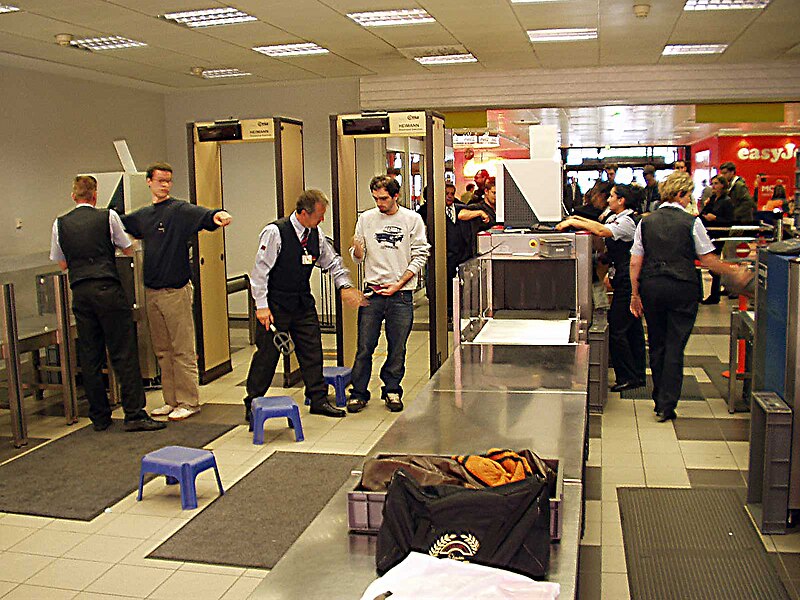
On checking in, every traveller in every airport around the world walks through a metal detector. Metal detectors work by electromagnetic induction – changing magnetic fields cause changing electric fields in metals, and vice versa. When a piece of metal is near the changing magnetic field being produced by the detector, electrical currents are induced in the metal, which then produces an alternating magnetic field of its own. This new magnetic field can then be detected and is why you need to remove metal objects like your belt when you walk through airport security.

Whilst you are walking through the metal detector, your bags are passing through an X-ray machine. As they move along the conveyor belt, X-rays, which are electromagnetic waves like light but much more energetic, are shone on the luggage. Many of the X-rays pass through unblocked by your suitcase and its contents, and detectors on the other side of your luggage measure how many of these X-rays make it through. By knowing that different things absorb different energy X-rays, a picture of your bag’s contents can be built up.

Explosives and Drug Detection:

Dogs have been used to sniff for explosives and drugs for many years, but it was only in 2003 that Explosive trace detection was introduced at Sydney airport. This system employs Ion Mobility Spectrometry. Firstly, a sample is taken by wiping a swab on your luggage or clothes. The swab is placed in the detector, and the sample is ionised – converted from its molecular form into its ionic (charged) form. The ions are separated by an electric field – different mass ions move at different speeds towards the detector, and so the time taken to arrive at the detector tells us if the telltale explosive, or drug, signature is present.

Another new method of explosive detection is terahertz spectroscopy. This technique uses radiation with a frequency between microwave and infrared, and can be more useful that X-rays as, although both X-rays and terahertz radiation can see through material, terahertz rays are non-ionising and so harmless to humans. They can also probe for chemical information, rather than just physical shape information, as many molecular excitations are within the terahertz frequency band.

Andrew Burnett, terahertz spectroscopy expert at the University of Leeds, says that the information obtained from terahertz spectroscopy is more sensitive than other radiation:

“This information is very specific, even allowing us to differentiate between different forms of the same drug… The aim is to eventually produce a system that gives us chemical specific information through clothing.”

Fingerprint analysis:

Fingerprint analysis is the oldest form of biometric identification, and is still regarded as one of the most reliable. Every visitor to the US has his or her fingerprint read on entry through an airport.

A fingerprint is an impression of the raised areas of epidermis – called friction ridges – on your finger, and everyone’s fingerprints are unique. You leave your fingerprints behind on things you touch by depositing the natural secretions – mainly water – from the eccrine glands in the friction ridge skin. These are called latent, which means hidden, fingerprints. If contaminants on the skin are also left behind, such as dirt, then they are called patent fingerprints. Patent fingerprints are easily seen by the human eye and so can be photographed and then identified as they are. Latent fingerprints are made visible by electronic, chemical and physical processing techniques such as “dusting” a crime scene.

Fingerprint analysis was traditionally completed manually by comparing the fingerprint with ink fingerprints on paper. As you can imagine, this was a very time consuming task. Modern day techniques are able to match fingerprints by using computerised databases.

An interesting fact is that the koala is one the few mammals that also has fingerprints.

Iris and Retina Recognition:
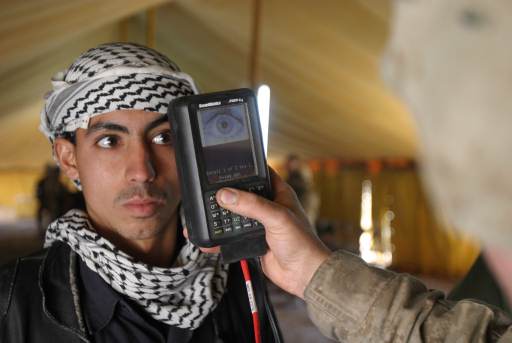
Iris scans look for patterns based on high-resolution camera images of the iris, whose intricate structure is unique to the person. Identification is unambiguous and as long as you do not damage your eye during your life, your iris scan will not change. The technology has been employed at Schiphol Airport in the Netherlands since 2001 to allow passport-free travel. The United Arab Emirates has such systems at all 17 air, land and seas ports.

Retinal recognition is slightly different, as the scan maps the capillaries feeding blood to the retina. These blood vessels absorb light more readily than the surrounding tissue, and when a ray of low-energy infrared light is shone into the eye, the reflection of the light, which depends on the capillaries, is measured. Even identical twins have different retinal scans, and like iris recognition, your retinal scan will stay the same throughout your life.

Facial Recognition:

Facial Recognition is a relatively new technology that compares facial features in the live image with those in a database. The Australian Customs Service’s SmartGate system compares the face of the examined with their image on their ePassport microchip, and replaced manual passport checks for Qantas staff in 2003.

Facial recognition is the way forward for the aviation industry, with the International Civil Aviation Organisation issuing a resolution endorsing the use of face recognition as the:

“globally interoperable biometric for machine assisted identity confirmation with machine-readable travel documents.”

Voice Recognition:

These days, it seems every time you call up your phone company or book a cab, you talk to a machine. These systems are based around voice recognition technology.

Clive Summerfield, biometrics and voice recognition expert, and CEO of Three S Holdings Pty Ltd in Canberra, thinks that over the next five years, voice biometrics will eclipse iris and facial scans and become second only in market share to fingerprinting systems.

“Voice recognition, when configured correctly, is 10 times more accurate that face, 2-3 time more accurate than fingerprint and approaching the performance of iris.”

Passports:

A new Australian passport, the biometric ePassport, was introduced in 2005 and has an embedded microchip that stores the holder’s photograph, name, gender, date of birth, nationality, passport number, and expiry date. European countries are currently issuing passports that have the owner’s photograph and fingerprints on the chip. The US passport has a chip that is big enough to store additional biometric information such as facial recognition and retinal scan information.

Will biometrics really shorten airport queues?

Even if these new technologies work perfectly inside the airport, they will not shorten check-in queues if the public does not like them or cannot use them. M. Angela Sasse, Professor of Human-Centred Technology at University College London, researches the usability of security systems and concludes that even if a system works well, it will not gain approval if it is not easy to use or looks unpleasant. A recent iris scan trial at Heathrow airport, in which participants could not adjust the height of the scanners, and a recent US airport trial, in which dirty fingerprint readers were used, are examples of poorly designed systems.

“You should design all the processes the traveller encounters to be as easy and pleasant as possible … Make sure the system is clean and pleasant to use.”

The ethics and future of biometrics:

Identity theft is one of the fastest growing crimes in the world, and estimates have valued identity-related crime as a $2 trillion problem. Biometrics is seen as a potent weapon in the fight against identity theft, however the concern surrounding biometrics is that there must somewhere be a database of your traits. Could someone steal this information? The common fear is that once your fingerprint or retinal information is stolen, it is compromised for life, as these patterns never change.

What differentiates biometrics from other forms of security is that there must be a match between the “live” biometric scan, and the “stored” information. Unless an identity-stealer has recreated your facial expressions or other biometric information to the minutest detail, they will not be able to pass through security.

Mathew James, Managing Director of UK Biometrics Ltd., says that the fingerprinting technology used by UK Biometrics is ethically sound as a biometric thief is likely to just end up with a bunch of useless numbers:

“We do not store fingerprints and it is impossible to recreate a fingerprint from the data we store. Our scanners register up to 17 minutiae points on a fingerprint, convert these into data which is then encrypted for future comparison. Even if this data were stolen, the thief would have a lot of meaningless numbers, useless without the scanner and its attendant technology.”

Whilst biometric technologies may tightly safeguard information, desperate thieves can, however, always find a way. In 2005, Malaysian car thieves cut off the finger of a Mercedes-Benz S-Class owner when attempting to steal his car so that they could use his fingerprints to start the vehicle. And the popular television show MythBusters broke into a secured building with a photocopied fingerprint.

Stephanie Schuckers, Associate Professor of Electrical and Computer Engineering from Clarkson University, conducts research into how to prevent fingerprinting systems from being spoofed by creating fake fingerprints out of such materials as Play-Doh, and thinks that biometric security systems are an improvement on traditional methods, even if there may be some vulnerabilities.

“I try to caution people to ask, what is your security question and what is your solution now, and does biometrics improve this in terms of whatever your goals may be – convenience, improved security. Just because there is a vulnerability – well all security systems have a vulnerability – it doesn’t mean it’s not necessarily a technology that might (not) be useful.”

Schuckers raises the example of a passport, and says that by adding a biometric element, you take a step forward to improved security.

“The current state of passports is a photo that may be 10 years old and a guy looking at you to see if it matches. Would adding a fingerprint improve the security at the borders? I would argue that that would be a step above the present technology. Can someone somehow slip a thin fake finger over their hand? Sure. That’s the state of the technology now, but you’ve made steps to improved technology.”

She believes that whilst there may be some vulnerability in biometric systems, they can be overcome by a combination of systems that would make it extremely difficult for the identity stealer to be successful.

“You can make it more difficult for someone to spoof the system by combining say a fingerprint, a card, and a PIN. So now your potential identity stealer would have to have all of those items to access the bank account… There are very simple steps that you can take now with commercially available devises that would minimise the risks”

Whether or not identity theft is likely or even possible, biometric systems are more and more being within society, with facial recognition software used in Closed Circuit Television (CCTV) all over the UK. Is this a breach of our privacy? Should Big Brother track our every move?

Schuckers believes that these are serious questions that need to be addressed by society, but that they also open up research areas to maintain the security of your personal information.

“I think those are reasonable questions that we need to ask as a society. What applications are meaningful that you would take the trade-off between privacy and the extra security you might get using the biometrics? I also see it as a research avenue. There are a lot of people researching ways to use biometric information in such a way that doesn’t actually give up your private information.”

Clive Summerfield sees the issue as a legal one, revolving around privacy and storage of sensitive personal information, as opposed to the technical challenge of safeguarding the information.

“At the end of the day, I think this will become a legal issue, where the privacy, protection and confidentiality of such information becomes legislated and that senior executives of organisations collecting, using, communicating and storing biometric information will become legally responsible for any breaches, along with biometric systems developers, implementers and vendors, who will be required to certify that their system implements the functions necessary to protect the biometric information.”

He draws a parallel with the postal service, in which stealing a letter is a federal crime, and thus protects the confidentiality of the contents of letters. There is a similar law regarding eavesdropping on telephone conversations, and these systems are widely accepted by society, despite the fact that there is little or no technological protection of information conveyed in these ways.

“Similar legal protection needs to be in place for biometrics for the mainstream of society to start to access biometrics… Anyway, I’m no legal expert – so how you go about implementing such laws, I’ll need to leave to the legal experts!”

Another concern is the storage of personal information on a single chip in your passport. Data on the chip can theoretically be stolen using wireless technology, and even if the information is encrypted, experiments in the Netherlands showed that the Dutch passport encryption could be cracked within two hours. Whilst you would never be able to set up the sensitive equipment to steal the information in our ever-more secure airports, the same could not be said about hotels and other places where you need your passport.

Mathew James thinks that in any situation in which there is a need to make sure of a person’s identity, there is a future for biometrics:

“Think of the number of keys, swipe cards, prox fobs and PINs that keep a modern airport secure. They can all be replaced by the one key which cannot be lost, stolen, forged or hacked – the human fingerprint. People can be added to, or deleted from, the system in seconds. Security staff can ‘access all areas’ without carrying a bunch of keys and passengers need only ever register once.”

As for biometric passports?

“We see a future where the only passport you will ever need will be your fingerprint, registered once in your home country.”

Saturday, 23 May 2009

Correlation of the Week: Zombies, Vampires, Democrats and Republicans

A friend of mine recently pointed me in the direction of an article in signonsandiego.com called With Obama election comes the return of the vampire. This article puts forward the theory that more vampire movies come out when Democrats are elected to the US Presidency, and more zombie movies come out when the Republicans are in office.

Recent evidence of this is the new Twilight vampire flick - coinciding with the election of Democrat Obama - and the spate of zombie films during George W. Bush's presidency - for example 28 Days Later, 28 Weeks Later and Dawn of the Dead. The original article looks back in time at various presidencies and it makes compelling reading.

What is the reason behind this (if there really is one)? One argument put forward is that the movies depict what we fear at the time.
Democrats, who believe in redistributing wealth among the people, fear the Wall Street vampires who bleed the nation dry. Vampires, such as Dracula, represent the aristocracy. Republicans fear a revolt of the poor and disenfranchised, and as such fear zombies.

But, is there any truth to this argument? Let's turn to the data. The easiest way to determine the number of vampire and zombie films which have come out over the last 50 years is to look at The Internet Movie Database. Using its power search, I was able to find the number of movies (not TV-movies , TV-shows or direct-to-video movies, but only big screen movies - imagine trying to quantify every TV-show ever made, not even imdb is that complete) made each year in the US since 1953 (a seemingly good point to start this analysis as there is plenty of data about the movies made in this time - it's also the presidency of Republican Dwight D. Eisenhower), as well as the number of movies tagged "vampire" and "zombie". You can see this data in the following table, where the year is the starting year of the presidency:

We've plotted the number of zombie and vampire films produced as a percentage of all films produced that presidential term in the US:

A stand out result is the large number of zombie films made in the 1980s under Reagan. It seems clear that zombie films peak in Republican years, but it is less clear whether vampire films have similar peaks under Democrats.

Indeed, the average percentage of movies that are zombie-themed produced during a Democratic presidency is 0.372%, whilst under the Republicans it is 0.571% - this is a large difference. The average percentage of movies that are vampire-themed produced during a Democratic presidency is 0.544%, whilst under the Republicans it is 0.491% - the percentage moves in the direction of our theory, but not by much.

Using a single-tailed Student's t-test (named after its inventor William Sealy Gosset, whose nom de plume was Student - I thought at school that it was named this because it was used by students, anyway...) to test between the null-hypothesis that the governing party makes no difference to the types of movies made and the theories that zombie movies go up under Republicans and vampire movies under Democrats, we find the t-statistic for the zombie case to be -1.69 which gives a p-value 5.7%. What this means is that there is a 5.7% chance that there is no significant difference between the zombie results under Democrats and Republicans. This is very close to the 5% level most statisticians accept for significance, and as such is a very intriguing result.

For the vampire case, our p-value is 33% and so there is little chance of significance. Both tests could be improved with more data (what every statistician needs!)

In summary, there just might be something in this (for the zombies anyway.) There is an almost significant difference between the percentage of zombie movies made under Democrats and Republicans. To predict the next election, it could well be worth looking at how many zombie movies are planned for the inauguration year and the 3 years after it. As most movies are planned more than a year ahead of time, this could be an interesting election predictor.

I guess we now know where George W. Bush's brains went! Brains.....

Thursday, 14 May 2009

Ep 106: The Global Financial Crisis - The Mathematical Causes

This week on the podcast we are tackling something dear to all our hearts, money.

The Global Financial Crisis has hit many people hard, with the resultant economic recession causing job losses, stock market crashes and company failures. But what started it all? Why are we in the midst of the worst financial crisis since the Great Depression?

I spoke to Nick Davis from the World Economic Forum to answer some of these questions and to toss up ideas on how we might emerge from the crisis. The World Economic Forum is an independent international organisation committed to improving the state of the world by engaging leaders in partnerships to shape global, regional and industry agendas. Nick is based in Geneva, Switzerland and is Associate Director and a Global Leadership Fellow within the World Economic Forum Scenario Planning Team. The team examines possible world scenarios that could arise in the future. The scenarios are not attempts to predict the future; rather, they aim to sketch the boundaries of the plausible. They explore the possibly diverse eventualities of how the world might look if the most uncertain and important drivers unfold in different ways. Some of the scenarios they have looked at include the world's ageing population, the future of engineering and construction and what the world's economic systems might look like post-crisis.

Nick has worked extensively in understanding the causes of the global economic crisis and chatted to me down the phone from Geneva. It should be noted that the opinions he expressed are his and not necessarily those of the World Economic Forum.

Listen to this podcast here:


We noted a number of causes of the crisis, including the fact that the world financial system was metastable - that is, before the crisis it was at a delicate equilibrium and susceptible to collapse. The factors that built this metastability included:

  1. A worldwide expansion of credit since 1980 - money became cheap as international monetary policy kept interest rates low. Essentially, you could borrow heaps of money from within your own country and outside of it, and lots of people were giving out loans;
  2. The subprime mortgage crisis - a large percentage of housing buyers in the US could not securely finance their property loans;
  3. The false assumption that housing prices always go up and the notion that we should all become homeowners - this created a housing bubble;
  4. Globalisation - more and deeper connections between institutions were created. This meant that when one company went down, it would trigger a collapse like a house of cards;
  5. Securitisation of home loans to make them tradeable. This meant the inherent risk that banks take on when they give out a loan was spread across many financial instruments, all across the world. This obscured the level of risk people were holding. Even rating agencies got the risk levels wrong. Here is where the maths comes in - and we got it wrong.
So what we did we get wrong with the mathematical models? For a start, they assumed a high level of liquidity, which means that it was assumed that whenever you wanted to trade, you could find someone to trade with . But this was not true - companies were unable to trade their securitised mortgages due to a loss of investor confidence, and so they were stuck with assets with falling value. Homeowners also found this when the bubble burst.

The models also used normal distributions of stock market movements. What's wrong with this, you may ask. Well, the world of finance unfortunately doesn't work this way. It is worth here noting the distinction between risk, which is something we can model, and uncertainty, which is more difficult. You can fit a probability curve to risk based on past experience - for example, you toss a coin, bet on tails but heads come up. You took a quantifiable risk. Uncertainty refers however to things you can't even predict.

Nick used the examples of Mediocristan and Extremistan to illustrate the difference between risk and uncertainty. In Mediocristan, everything fits nicely under a bell curve. Extreme events are so rare that we can essentially ignore them. For example, if you surveyed 1000 people and plotted their weights, you would come up with something like a normal distribution. If you then found the heaviest person on Earth, he would be to the far right of our curve, but not so much that the normal distribution fit would become inappropriate. Finance, however, does not work this way. Imagine you surveyed the incomes of 1000 people. This may also look like a normal distribution - but then take the richest man on Earth and look at what it does to the distribution. Bill Gates would probably earn more than everyone you sampled put together. This is Extremistan. The worlds were the inventions of Nassim Nicholas Taleb who came up with the idea of the Black Swan. The name comes from the idea that before black swans were discovered, everyone thought swans were white - they had no reason to think otherwise. This is an example of uncertainty as you can not quantify the probability of finding a black swan when you don't even know they exist.

It's very difficult to deal with black swan events - like in Extremistan when we discovered someone a million times richer than anyone we have ever seen. The mathematical models dealing with securitised mortgages attempted to model risk in a far too simple way and did not take into account the uncertainty of the entire housing market collapsing (many defaulting on their loans at once - our black swan). The fact that uncertainty is so difficult to model is why we have the World Economic Forum Scenario Planning Team!

Listen to this podcast here:


And for all the Nick Davis fans out there, check out his blog Managing Uncertainty and watch the following video of Nick in action for the World Economic Forum. Thanks again Nick!


There is more from the World Economic Forum and the Global Financial Crisis on youtube here.

Tuesday, 12 May 2009

The Muppets are responsible!

Having spent the night browsing around youtube, it seems to me that The Muppets might have some explaining to do re bird flu and swine flu.

Bird flu, or more specifically Influenza A virus subtype H5N1, is considered a significant pandemic threat. It is passed between birds in their saliva, nasal secretions and faeces, and past outbreaks in humans have started in crowded conditions, where humans and chickens live in close quarters. In these conditions the virus is more likely to mutate into a form that can infect humans. It is thought that some of the humans who have died from bird flu were cock fighters who sucked the mucus from the bird's beak before a fight. There are some suspected cases of human-to-human transfer.

Keeping this in mind, check out what the Swedish Chef is doing to this poor turkey. He is not only kissing it, but prodding it rather inappropriately with his skewer and exposing himself to the turkey's body fluids...


Swine flu is a new strain of Influenza A virus subtype H1N1. H1N1 is the most common cause of influenza (flu) in humans. The new strain seems to be a new mix of the genetic material of the human influenza, swine influenza and avian influenza viruses. One of the reasons why this new flu is considered a significant threat is that it is now being spread human to human. This contrasts bird flu which was almost entirely animal to human. As the strain is new, we have no natural immunity, nor are we vaccinated against it, so there is a considerable threat of a pandemic. Currently we are not sure if the virus originated in pigs, humans or birds. Check out this video of Miss Piggy, she does sneeze and spread her flu around a lot - I think she might have been the source!


So essentially the major flu outbreaks of the 20th Century are due to The Muppets. Not to mention the rats they have running all over the place, I'm sure they had something to do with the Plague...

Saturday, 2 May 2009

Ep 105: Music and Intelligence

This week's podcast is about a recent study that correlated intelligence with music choice - it won our new regular prize Correlation of the Week!

You can read more about this study in the original Mr Science post on the topic put out in March 2009 - Correlation of the Week: Intelligence and Music Preference

Listen to his podcast here:


Friday, 1 May 2009

Mr Science over at the 365 Days of Astronomy Podcast

A little while back in our 99th episode, we discussed the 6 unknown mysteries of our solar system. This show has recently been played in the 365 days of astronomy podcast, which is a project that publishes one astronomy-themed podcast per day for all 365 days of 2009. 2009 is the International Year of Astronomy, which is described as a global effort initiated by the International Astronomical Union and UNESCO to help the citizens of the world rediscover their place in the Universe through the day- and night-time sky, and thereby engage a personal sense of wonder and discovery.

Monday, 20 April 2009

Ep 104: Invasion Genetics

Dr Katarina Mikac works in an area of science with a fantastic name - Invasion Genetics.

Invasion Genetics is an area of molecular ecology. Molecular ecology is the study of how organisms interact with their environment from a molecular point of view - that is, it examines the roles of DNA and genetics in how species adapt to their environments. It's also part of the larger field of evolutionary biology which looks at the origins of species and how they evolve over time.

Specifically, invasion genetics tracks the movements of invasive species using their DNA - you can't put tracking devices on insects!

One of Katarina's research areas is the Khapra bettle - the world's most destructive seed-eating pest. The beetle feeds on grain and seed kernels, and can decimate storage systems. In fact, heavy infestations can destroy thousands of kilos of stored grain in a matter of weeks. However, it is not present in Australia and this is where Katarina comes in. Australia plays host to the khapra's sister species, from which it is virtually indistinguishable, but by using DNA fingerprinting, Katarina is aiming to develop a species identification test which could identify the beetle at airports and stop it from coming into the country. Another aim is to investigate the sister beetle's genetic diversity and gene flow in order to understand its distribution and movement patterns. This will lead to better understanding of the consequences of the inadvertent introduction of the khapra beetle.

Katarina's current work is on the population genetics of the invasive Western Corn Rootworm which destroys corn if left untreated. In the United States, it is estimated that 30 million acres of corn (out of 80 million grown) are infested andvthat Corn Rootworms cause $1 billion in lost revenue each year.

In 2007, Katarina won the 2007 Science and Innovation Award for Young People in Agriculture, Fisheries and Forestry for her work on the Khapra bettle and is just about to leave our shores for a series of conferences in Germany and Croatia on the Western Corn Rootworm - good luck Kata!

Listen to his podcast here:


Thursday, 9 April 2009

The Hand of God

With Easter coming up and all sorts of religiosity going on, here are a couple of heavenly photos from space. The first, looking spookily like a hand, comes from the Chandra X-ray Observatory. At the centre of this image is a very young and powerful pulsar, known as PSR B1509-58. The pulsar is a rapidly spinning neutron star which is spewing out energy to create the shapes we see in this photo, including the one that resembles a large blue hand. In this image, the lowest energy X-rays are red, the medium range is green, and the most energetic are blue. The pulsar is only around 20 kilometres in diameter but the nebula spans 150 light years. For more amazing photos from Chandra, check out their flickr gallery. This image came out on April 3 2009.


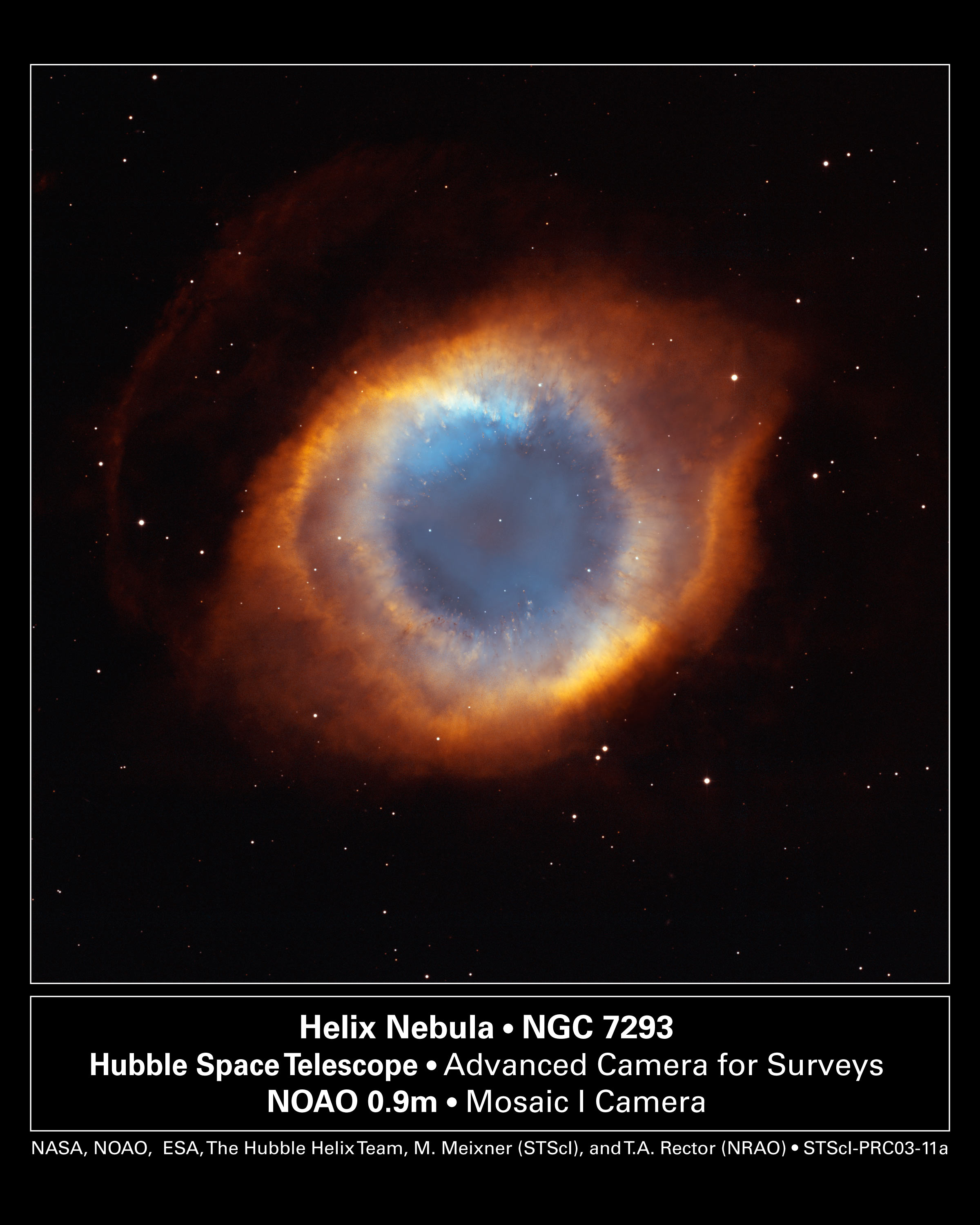
The second is one you may have seen before - perhaps in a spam email. It has been dubbed The Eye of God and was featured on NASA's Astronomy Picture of the Day in 2003. It is the Helix Nebula, which is a planetary nebula created at the end of the life of a Sun-like star. Gasses are expelled into space to make it look like we are looking down a helix. The remaining core glows so much so that it causes the previously expelled gas to fluoresce. It seems God has blue eyes and a lot of redness around the outside, suggesting he stayed out a little too long the previous night.

One of these days someone should put together all these images so we can finally find out what He looks like. Looking forward to someone spotting the beard in space one day...

Friday, 27 March 2009

Ep 102: Earth Hour

Earth Hour is a WWF initiative where individuals, businesses and governments turn off their lights for one hour to show their support for action on climate change. It is a symbolic event designed to engage people in the climate change discussion in order to send a strong message to political leaders that we want them to take meaningful action on climate change. It claims to be the largest climate event in history and it is hoped that one billion people around the world will participate - not bad for an event that started quite small in Sydney a few years back!

Sign up for Earth Hour


The focus of Earth Hour 2009 is the United Nations Climate Change Conference to be held in December in Copenhagen. This conference will create a post-Kyoto Protocol international agreement to tackle climate change. This year, Earth Hour takes place on Saturday, March 28, 2009 at 8:30 pm-local time. Just like New Years Eve, Earth Hour will travel from time zone to time zone starting at 8:30pm in New Zealand.

This week on the podcast I chat to the Mayor of Willoughby City Council in Sydney, Councillor Pat Reilly, about the Earth Hour activities his council is putting on and how Willoughby is combating climate change. Interesting points include:
  • The Council is launching its ClimateClever campaign at the festival;
  • Willoughby is committed to assisting its community to reduce its carbon footprint by at least 15% from 2006 levels by the end of 2015 - far better than the Australian federal government targets of a reduction of 5% by 2020;
  • The Council itself is aiming to reduce its greenhouse gas emissions by 50% from 1999 levels by the end of 2010.
In the second half of the podcast, I talk to Dr Ben McNeil, a Senior Fellow at the Climate Change Research Centre in the University of New South Wales. This interview is a cut-down version of a longer one I will put out in the coming weeks. Ben is a highly impressive young scientist who, after completing his PhD in 2001, worked as a research fellow at Princeton University before taking up his post at UNSW. In 2007, he was chosen as an expert reviewer for the United Nations Inter-Governmental Panel on Climate Change and briefed his work to the Prime Minister. Ben and I chatted climate change science, policy and energy.

Listen to his podcast here:


I'd also like to make a comment about an opinion piece that came out today in The Australian newspaper Hour of no power increases emissions by Bjørn Lomborg, who is the director of the think tank Copenhagen Consensus Centre. Lomborg is a controversial bloke - check out his wikipedia page - who opposes the Kyoto Protocol and other measures to cut carbon emissions in the short-term, and argues that we should adapt to short-term temperature rises and spend money on research and development for longer-term environmental solutions.

He said in the article:

"Unfortunately, this event - as with many public proposals on climate change - is an entirely symbolic gesture that creates the mistaken impression that there are easy, quick fixes to climate change.... Even if a billion people turn off their lights this Saturday, the entire event will be equivalent to switching off China's emissions for six short seconds.... The campaign doesn't ask anybody to do anything difficult, such as coping without heating, airconditioning, telephones, the internet, hot food or cold drinks."

Well, he is correct in a practical sense, but for me he misses the point of the whole exercise. Of course Earth Hour in itself doesn't much reduce emissions. But by the same token, the 40-Hour Famine doesn't in itself save people living in poverty and starving. Both these exercises are mainly about raising awareness and showing politicians we care about the topic (and to raise some money too). There may be no quick-fix to climate change, but unless we pressure them, politicians and industry representatives won't take the steps needed to develop any solutions at all. In case you haven't noticed, many governments around the world are using the current financial crisis as an excuse not to do anything about climate change. The problem is however, that even if we go into a economic depression for 10 years, climate change is going to be around for hundreds. Governments are so short-sighted and various parts of the community so scared of change that no one is willing to take the plunge to do anything real about climate change. I agree with Lomborg that there are no easy solutions and we must look at longer-term fixes, but unless we get the entire community on-board, then governments have shown that they won't do much - just look at our own Australian government's weak emission targets. Market forces will not solve our climate change problems in time, which is why we need to pressure governments to implement measures such as a carbon-tax and to fund renewable energy projects so that we can make the market work for us, not against us. And we need to convince industry it's nothing to be scared of - various industries were worried that the introduction of OH&S laws in the 1980s would be bad for productivity without seeing that a safe work-place is better for growth as well as staff. Anyway, Earth Hour is about raising awareness and making it impossible for governments and industry to do nothing. End rant.

Tuesday, 17 March 2009

Correlation of the Week: Intelligence and Music Preference

The other day I heard loud distorted music approaching from a hotted-up 1986 Holden Calais with mag-wheels and a ridiculously loud sub-woofer and thought:
  1. I wonder what this guy is compensating for, and;
  2. His music taste probably says a lot about his intelligence.
Well, the study has been done. Before we jump into it, it's worth saying that the author of this study, Virgil Griffith from California Tech, makes no claims about correlation equalling causation. He just presents his results and allows us draw our own conclusions. His method of correlating music with intelligence involved:
  1. Find the ten most frequent "favourite music" descriptions at every US college via that college's Network Statistics page on Facebook;
  2. Download the average SAT/ACT score from CollegeBoard for students attending those colleges;
  3. Correlate the Facebook music results with SAT/ACT results and draw your own conclusions on music taste and intelligence.
The artist associated with the highest intelligence, by a clear margin, is Beethoven, whilst some rapper by the name of Lil Wayne seems to be loved by those less blessed in their mental faculties. The study also showed that Counting Crows, Sufjan Stevens, Radiohead and Ben Folds Five appealed to big brains whilst very disappointingly, for me anyway, Beyonce is at the other end of the scale. According to the data, people who listen to "indie" music are the smartest, and the genres come out:

Soca < Gospel < Jazz < Hip Hop < Pop < Oldies < Reggae < Alternative < Classical < R&B < Rap < Rock < Country < Classic Rock < Techno < Indie

It's tempting to think that intelligence has a direct impact on music choice, but this is probably not true - I know plenty of research scientists into Britney Spears. And the reverse - that music-choice influences your intelligence - doesn't make sense either, even though you may be occasionally tempted to think that listening to mindless dance-music makes you stupid. Could there be some drivers that influence both intelligence and music choice? Possibly. You can imagine that socio-economic factors and what you are exposed to whilst growing-up would influence the music you like and how well you do at school. Your parents would be a big influence too - I just can't shake Wet Wet Wet... There are countless possibilities that are best mulled over at the pub.

Whatever the case, I'm heartened by the results! We've already done a story on visualising music tastes using Last.fm, and most of my favourite artists are in the top half of the table with indie my favourite genre. For more on science and music taste, check out the podcast we put out in 2006 - one of the very first Mr Science Show episodes down the phone to China Radio International - called Can Scientists Predict Your Music Taste which looks at how web applications such as Last.fm and Pandora recommend songs to you based on your listening habits.

Griffith's study on music and intelligence comes on the heels of his "books and intelligence" study, in which he correlated book tastes with intelligence again using Facebook data. Harry Potter is the most popular book with The Bible second (for some reason, The Bible and The Holy Bible are different books). Some of the results include:
For more on the book study, check out booksthatmakeyoudumb. And for more on the music study, see musicthatmakesyoudumb. The following picture is one of the ways Griffith visualised his results. See where your favourite artists lie.

So congratulations to Virgil Griffith and your study on music tastes and intelligence, you have won Correlation of the Week - the Flying Spaghetti Monster would be proud!

Friday, 13 March 2009

Ep 101: Molecular Design

Dr. Luke Hunter is an organic chemist whose chemistry career has been based around molecular design - that is, designing organic molecules through experiment.

I grabbed Luke over a few cocktails and chatted organic chemistry, molecular synthesis and design, and the Hollywood lifestyle that organic chemists lead. This podcast also has our first Correlation of the Week. Listen to his podcast here.

Organic chemistry is a part of chemistry looking at compounds that contain carbon. The original definition of organic chemistry was "the chemistry of life" as it was thought all organic compounds had something to do with life - these days we know that there are many organic processes that have nothing to do with life, as well as many inorganic compounds that are essential for life.

One of Luke's research areas in the School of Chemistry at the University of NSW is to design molecules that can bind with DNA. By designing molecules in this way, it is hoped that drugs which can target particular genetic sequences in DNA can be developed. This could lead to advances in genetics research which could allow us to turn certain genes off and on, and could eventually lead to cures for genetic disorders such as infertility. To do this, Luke goes fishing! Luke dangles a strand of DNA into a soup of organic compounds to see which ones stick. Those that stick have the right shape to bind to DNA and so can then be further investigated. Different strands of DNA can be dangled into the soup - that is, different fishing lines can be used - and in this way, molecules that selectively bind to only one section of DNA can be found.

Luke's other area of interest is Fluorine Chemistry - he worked in this area whilst studying at the University of St Andrews. Again his work was in designing molecules with particular shapes. Knowing the shape of a molecule and how it behaves is very important for designing drugs to fit receptors in the body - when a receptor is bound by a molecule (for example, a drug), biological activity is generated (for example, nerve impulses send a message to your brain). Luke often works with Hydrofluroric acid, a strongly corrosive acid that is so dangerous you need to carry an antidote for it at all times when working with it - this antidote is calcium gluconate. HF burns may not initially be painful but as HF penetrates the skin, it can etch and weaken bones without damaging the skin. It can also be absorbed into blood and react with blood calcium, causing cardiac arrest. This is why calcium gluconate is used - it is a source of Ca2+ that sequesters the fluoride ions. If left untreated, amputation may be required.

Luke's PhD was in the total synthesis of a fungus that could be used to kill cancer cells. Total synthesis is the complete chemical synthesis of complex organic molecules from simpler pieces. Synthesising the molecule to selectively target cancerous cells is very difficult and one of the reasons why chemotherapy drugs have such terrible side-effects - they affect not only the cancer cells but other healthy cells.

Whilst it may seem that Luke leads the Hollywood lifestyle, carrying around antidotes to dangerous chemicals and all, Luke is perfectly happy with the relaxed lifestyle of an organic chemist in a white lab-coat:

"Day-to-day I'm wearing a white coat and safety glasses and I'm mixing together different compounds in round bottom flasks - it's not especially glamorous but I enjoy it anyway."

Luke is about to commence a post-doc at the University of Sydney.

The second part of this podcast is our new segment Correlation of the Week - dedicated to bad and funny correlations that make the news. You can read more about this week's correlation in our article from a few days back Correlation of the Week - Shark Attacks and the Global Financial Crisis

Listen to his podcast here:


Friday, 6 March 2009

The Open Laboratory 2008

The 2008 anthology of the best 50 science blog-posts from the year, The Open Laboratory 2008, is now available.

It is the 3rd annual anthology of science blogs with this year's considerably better as it includes one by me! This was quite a nice surprise - I heard about Open Labs at the London Science Blogging Conference and quite a few of the bloggers in attendance were hoping to get in, so I'm quite chuffed - thanks!

There were around 830 submissions narrowed down to 50 essays, one poem and one cartoon. If you missed them first time around, you can still buy the 2006 and the 2007 anthologies. Both of those, as well as the new one, are available in paperback or as a PDF download at lulu.

You can buy the book from lulu - no profits come to me, but go to funding the Science Online science blogging conference.

For what it's worth, my post that made it was one I wrote for Plus Magazine called United Kingdom - Nil Points about the maths of the Eurovision Song Contest. Amusingly, as the title is a bit of an in-joke for Eurovision fans, the name of the article was changed to Political Music for the mainly US audience this book will attract!

The article starts:

It is one of my favourite times of year, and I'm not even European.

The Eurovision Song Contest to Australians is a strange mix of bad 80s music, songs about "joy", "love" and "unity", amazingly good-looking hosts, scantily dressed Eastern Europeans and reality TV winners from Western Europe.

But another reason I love it is because it is about politics and maths. For the first time in my life, living in the UK, I get a chance to vote for the winner and watch it live instead of having to ignore radio reports (of course it's all over the news) till the Sydney Sunday evening replay.

I guess this year I'll be avoiding the news all day so as not to ruin the delayed Sydney SBS coverage! Get over to Plus and read the original article, or even better, buy the book as a PDF or paperback from lulu.

Counting down to Geek Pop

In less than one day now, the Geek Pop 09 Music Festival will kick off.

Geek Pop is a free online music festival that brings together science-inspired artists from around the globe in a gleeful celebration of geek culture. The festivities kick off on the 6th March (UK time) and runs until the 15th as part of National Science and Engineering Week in the UK.

What is great for us geeks who don't reside in the UK is that it is a virtual festival - it is completely online. Sometime later on today the Geek Pop site will be transformed and we’ll have access to geeky music from all over the world, as well as interviews, lyrics for every song and geek chic festival merchandise. There will also be a festival highlights podcast.

To find out a little bit more about Geek Pop, check out the Episode 94 of my podcast, in which I spoke to festival organiser Hayley Birch about the festival, where the idea came from and what type of music we can look forward to.

And check out this youtube advertisement for Geek Pop by molehillmedia - very amusing...


See you there, virtually that is...

Wednesday, 4 March 2009

A Month of Maths

It must be the geekiest month of the year. March plays host to three days dedicated to mathematics.

At this very moment, parties are raging around the world in celebration of Square Root Day - 03/03/09 (3 being the square root of 9). Square Root Day only occurs 9 times a century - the last time was 02/02/04 and the next time will be 04/04/16. As it's 7 years till the next one, make sure you celebrate hard! There is even a facebook group you can join to connect with fellow square-root fans.

And maths fans are likely to keep their parties going, as the following day, March 4th, is World Maths Day. World Maths Day takes place each year on the first Wednesday in March and is one of the world’s largest educational events. Its aim is to lift numeracy standards and is free of charge for both schools and students. Check out the World Maths Day website for ways to get involved.

Maths fans then get a few days rest before starting up the celebrations again for Pi Day. Pi Day is observed on March 14th (03/14 in the American date format), as π is roughly equal to 3.14. Pi Minute is celebrated on March 14 at 1:59 am and Pi Second at March 14 at 1:59:26 am (π to seven decimal places is 3.1415926) .

So, before you complain to the police about the loud music coming from your neighbour's place after midnight this month, take a moment to consider that it's probably from a maths party - let them have their fun. We mathematicians don't get invited to many parties...

Monday, 2 March 2009

Ep 100: Your Top 10 Science Stories from 2008

With 2008 done and dusted, it is now time to look back and reflect on the science year that was. It is also our 100th podcast episode, so I would like to say thanks very much to all my subscribers, whether you get your Mr Science fix via the podcast, email, in an RSS reader, however you do it, thanks! If you have, by some chance, listened to all 100 episodes, then I'd love to hear from you as not even my parents have listened to them all....

The winner of our 2008 year in science competition is... Dr Steven Farrell from Cork in Ireland. Congratulations Steven! Steven won the random draw for suggesting the Large Hadron Collider as his favourite science story from 2008. Thanks to everyone who entered the competition and suggested stories - each story listed below was entered by at least one person. Steven has won the book The Open Laboratory: The Best Science Writing on Blogs 2008 - the book will be published very shortly and will feature one blog by me - I'll put out a post about this when the book comes out, but in the meantime, check out the 2007 version.

Listen to his podcast here - includes short snippets from the music of 2008, plus a couple of shout-outs from friends of the show (thanks Brains Matter and Jacqui Hayes from Diffusion):


Now to the countdown....

10. Weird Animals

2008 was a year for weird science emanating out of Europe:


9. Weird Research (impacting our sex lives...)

Two bits of weird science that made the news in 2008 will have quite an impact on our sex lives:
  • But the researchers from California who confirmed that the humble roll of sticky tape is a source of x-rays should perhaps concern us. The researchers admit that Soviet scientists had found something along these lines in the 1960's, but still don't know how it works. We should all think twice about wrapping Christmas presents with the tape dispenser close to our nether regions...


8. The Kakeya conjecture

And now for some difficult science, and the work of Zeev Dvir and Australia’s own Terence Tao on the Kakeya conjecture is mind-blowing, if you understand it.

The Kakeya conjecture is part of geometric measure theory and stems from the Kakeya needle problem posed in 1917:

What is the least area in the plane required to continuously rotate a needle of unit length and zero thickness around completely (i.e. by 360 degrees)

For instance, you can rotate a unit needle inside a unit disk, which has area π/4. By using a deltoid one requires only π/8 area. See here for an animation of that rotation.

In 1928, a bloke by the name of Besicovitch showed that in fact you can rotate this needle in an arbitrarily small amount of area – that is, essentially zero area. This seems unintuitive, but is not too difficult to picture. Imagine you have a needle and you slide it along the direction it points for some distance (which costs zero area - remember the needle has zero width). Then turn the needle slightly, which costs a small amount of area, slide it back and turn it slightly again. Then slide up, turn, slide back, turn etc. At each turn you rotate in the opposite direction to the last. If you keep doing this until the needle has completed 360 degrees, the amount of area that has actually been used to turn the needle gets smaller and smaller for smaller and smaller turns at the end of each needle slide. Check out this animation to see this idea in action.

The Kakeya conjecture concerns the fact that you can make this needle turn through arbitrarily small amounts of area, and takes it into higher dimensions (that is, not simply 2 dimensions). Zeev Dvir, who according to Terence Tao produced a “beautifully simple argument”, proved a special case of the conjecture, the finite field Kakeya conjecture.

Perhaps this should have made my mathematics highlights of 2008


7. The creation of artificial bacteria by Craig Venter

Scientists have discovered a more efficient way of building a synthetic genome that could one day enable them to create artificial life. The method is already being used to help develop next generation biofuels and biochemicals in the labs of controversial US scientist Craig Venter.

Venter has hailed artificial life forms as a potential remedy to illness and global warming, but the prospect is highly controversial and arouses heated debate over its potential ramifications and the ethics of engineering artificial life. The J. Craig Venter Institute succeeded in synthetically reproducing the DNA of a simple bacteria last year.


6. Chandrayaan moon landing by India

India became the first country outside the US and the old USSR to land a spacecraft on the moon. Its lunar orbiting spacecraft Chandrayaan 1 released the Moon Impact Probe, which reached the surface of the Moon on Nov 14 2008. This date was chosen to commemorate the birthday of Jawaharlal Nehru, the first Indian Prime Minister who initiated India's space program. Developed in India by the Indian Space Research Organisation, the MIP had the Indian flag painted on its exterior. Although Japan and Europe had previously commanded their orbiters Hiten and SMART-1 to crash on the Moon's surface at the end of their lifetimes, India's MIP was the first probe designed specifically for a trip to the lunar surface since the Soviet lander Luna 24 in 1976.

The Indian MIP-1 probe did not include braking rockets and was destroyed upon impacting the lunar surface at its planned speed of 3,100 miles per hour.


5. Stem Cell Fraud

One of the less savoury aspects of science is fraud. In 2006, South Korean Hwang Woo-suk fabricated stem-cell results in two academic papers, and in 2008, stem-cell fraud again hit the headlines.

Morayma Reyes, a former member of one of the highest-profile teams in stem-cell biology, was found to have falsified results. In 2007, the work of Catherine Verfaillie and researchers from the University of Minnesota became mired in controversy, after magazine New Scientist pointed to irregularities in their published results. An expert panel was examined and it was found that PhD student Morayma Reyes had falsified data.

The fraud is significant as in 2002, the team published a paper in Nature suggesting that a rare type of adult stem cell from bone marrow could give rise to all of the body's tissues. Such versatility had previously been seen only in embryonic stem cells. This was an astounding result and opened the door to creating cell-lines in a more “ethical” manner than using embryos.


4. The Story of HM

The most moving science story from 2008, and certainly some of the best science writing, comes from the New York Times and concerns the life and death of Henry Gustav Molaison, known as HM.

HM knew his name, that his father’s family came from Louisiana and his mother’s from Ireland. He knew of the 1929 stock market crash and World War II, but not much more. He could not remember anything of his life before 1953, when he underwent an experimental brain operation to correct an epileptic seizure disorder. He emerged from the operation with profound amnesia and had lost the ability to form any new memories.

For the next 55 years of his life to 2008, everything he did, from meeting someone, to going for a walk, eating dinner and watching TV, in his mind, it was the first time he had ever done it. And throughout those 55 years, he was recognised as the most important patient in the history of brain science. He took part in hundreds of studies and contributed immensely to our understanding of learning, memory and what it means to be human. HM died in 2008.


3. Discovery of water ice on Mars

I love the fact that it was a Mars Phoenix twitter status update that confirmed what many of us had always hoped, that there is water ice on Mars.

Water-ice has been found in vast quantities just below the surface across great swathes Mars. Some people are now arguing that NASA should now commit itself to a manned landing within 20 years. The discovery was made by the Mars Odyssey spacecraft and now seems to answer a long-unanswered puzzle, where did all the water on Mars go? We’ve known for a while from valleys on Mars that water once flowed and we used to ask whether all the water evaporated into space because of the lack of atmospheric pressure on the surface. Now it seems it all froze underground. If it all melted, Mars would be completely covered in a planet-wide ocean!

Incidentally, the Mars Phoenix Lander won a Shorty award for twitter its efforts.


2. Climate Change

Climate change will feature in every top 10 of science from now until the year 3000, if we’re still here and writing blogs and recording podcasts - and it's making its third appearance on this blog after topping the 2006 list and coming in 9th in 2007. The hole the in ozone layer was the second largest in history, the Arctic experienced its second smallest cover of ice, and after remaining flat for a decade, methane levels started to rise again.

The Australian government let nearly everyone down with its soft carbon targets, and concerns have mounted over the global production of biofuels which have been grown in place of food crops.

Watch this space, I’m sure climate change will feature again in 2009.


1. The Large Hadron Collider

In the words of Dr Steven Farrell, our competition winner...

I loved the LHC for a couple of great reasons. Firstly, growing up in the age of Bond villains who were intent on gigantic technological pieces capable of destroying the earth, I loved the idea that the collider might possibly generate a black hole and consume the earth thus destroying all evidence of human existence. Awesome. I don't care if any number of physics associations came out and said it wouldn't happen. They couldn't be 100% sure that it wouldn't. Fantastic. And the second reason is obviously that this rather expensive piece of technology that took a fair bit of time to put together broke. And pretty darn quick too. So yeah, that's my highlight.

It cost approximately US$10 billion to build, and almost 20 years to complete, got everyone excited, then it broke. For about week, everyone was an expert on the Higgs boson and fearful that the LHC might create a mini-black hole, which would not only swallow the Earth, but the whole Universe! After a few tests and no black holes, a small fault in one of the magnets caused the LHC to be shutdown. Watch this space in 2009.


......................


So there you have it, the top 10 science stories from 2008 as contributed by Mr Science Show lovers. Thanks to all who contributed and we'll do it all again next year! Please let me know of any stories you would have liked to have seen - and please write and say hi if you're a long-time listener of the show!

Listen to his podcast here:

Friday, 27 February 2009

Correlation of the Week: Shark attacks and the Global Financial Crisis

We've looked in the past at poor correlations - for instance, it wasn't too difficult to show a relationship between the performance of the Australian cricket team and the price of oil - whilst it looks intriguing, it would be wrong to read anything into it. In this vein, I thought we'd introduce a new recurring award, that of the venerable Correlation of the Week! (Although it probably won't come out weekly...)

This award is dedicated to work proclaiming a cause-and-effect relationship when one probably doesn't exist. Often it's not the fault of the scientists involved - scientists are wont to musing upon possible reasons for their results. No, it's generally the media playing up the story for effect.

A quick reminder of our 3 reasons correlations can occur:
  1. There is a direct cause and effect relationship between the two data sets;
  2. There is an underlying reason for the two data sets to move together, as opposed to one causing the other;
  3. There is no cause and effect and no underlying reason for the correlation - it's simply a coincidence or the work of a devious statistician.
Correlation of the Week deals with the 3rd reason - that is, when there is no cause and effect at all. And the inaugural prize goes to....

Shark Attacks Drop Due to Global Financial Crisis

Reuters recently reported that the number of fatal shark attacks in 2008 dropped from the 2007 result of 71 to 59, and placed the blame (if that's the right term) at the feet of the GFC.

George Burgess, who directs the International Shark Attack File at the University of Florida, said:

"I can't help but think that contributing to that reduction may have been the reticence of some people to take holidays and go to the beach for economic reasons."

This is rather tenuous speculation. There are quite a number of issues involved here:
  1. Is the data accurate? Have they captured every fatal shark-attack across the whole world over the last year?
  2. Is the decrease simply noise? What about other years? Two data points don't tell us much.
  3. What other factors are involved? Fishing, oceanography, where the attacks occurred, availability of medical resources, the list goes on. Surely more than economics.
Indeed, the ISAF states many of these things in it's initial report on the topic - which incidentally is a nice summary of the issue. Indeed, they state:

"Year-to-year variability in local economic, social, meteorological and oceanographic conditions also significantly influences the local abundance of sharks and humans in the water and, therefore, the odds of encountering one another. As a result, short-term trends in the number of shark attacks - up or down - must be viewed with caution.
"

The ISAF prefers to look at the data on a larger time-frame, and when doing that, the data suggests that shark attacks are going up because humans are spending more time in the ocean (a fair conclusion to draw), despite the fact shark numbers are getting smaller.

"Even with the recent levelling trend, the number of unprovoked shark attacks has grown at a steady pace over the past century. Overall, the 1990's had the highest attack total of any decade and the first decade of the 21st century will exceed that total."

The ISAF also notes that it's data could have errors in it, suggesting that the difference between 2007 and 2008 could be noise or data inaccuracy:

"The ISAF's efficiency in discovering and investigating attacks has increased greatly over the past decade, leading to further increases in attack number. Transfer of the ISAF to the Florida Museum of Natural History in 1988 resulted in greatly expanded international coverage of attack incidents and a consequent jump in the number of documented attacks.... Fundamental advances in electronic communication, a greatly expanded network of global ISAF scientific observers, and a rise in interest in sharks throughout the world, spawned in part by increased media attention given to sharks, have promoted more complete documentation of attack incidents in recent years.... Our strong web presence regularly results in the receipt of unsolicited documentation of shark attacks. Many of these attacks likely would have been missed in the past."

So congratulations to the first recipients of Correlation of the Week! The award is brought to you by the Church of The Flying Spaghetti Monster, which blames global warming on the fact that pirate numbers are reducing (and therefore offending TFSM).

So I say to you Reuters and those correlating shark attacks with the economy:

"What would the Flying Spaghetti Monster Do?"


Tuesday, 17 February 2009

The words of 2008

I recently stumbled across this wonderful visualisation tool called Wordle.

Using Wordle, I have created this image of the most popular words on The Mr Science Show blog throughout 2008 (not including common words like "the" and "and".)

The words most used on the Mr Science Show blog throughout 2008

It's nice to see that science is number one on the list! The image is quite a nice reflection of my interests in 2008, with maths and mathematical words such as distribution, stats and one featuring. We have sporting words such as cricket, league and sport, a few words artistic words such as music and dance, and some that need no explanation - sex and condoms....

I've started to become a little addicted to Wordle, so here is our DSTO Operations Research Code of Best Practice document - looks like a new funky ad campaign for studying mathematics!

The words most used on the Mr Science Show blog throughout 2008